
Murmuration of Starlings

A Murmuration of Starlings
What is a Murmuration of Starlings? It really isn’t much except being a fancy way to describing a group of European Starlings that you might find together. The Encarta Dictionary says; mur•mu•ra•tion (noun) 1. murmuring – an act or sound of murmuring 2. starlings collectively – a flock of starlings! Many other critters have different names for describing there group gatherings. . . . here are a few my favorite examples; “a cloud of gnats”, “a walk of snipe” and “a band of gorillas”!! I wonder if the gorillas have hippy gorillas or monkeys who follow them from gig to gig?? (more…)
Annual Waterfowl Survey
Today a few of us from the Cattaraugus County Bird Club participated in the NYS DEC / NYSOA annual waterfowl survey. Each January a quarter of a million ducks across New York State are counted by bird clubs, state officials and your average birder. We are also participating in the Mid-winter Bald Eagle Survey, where we are locating Eagles wintering along the Allegheny River. The results of these two surveys will help determine the long-term monitoring of waterfowl and Eagle populations within New York State during the winter months.

Canada Goose with a cold wake up call.
An Interesting Office Visitor
Have you ever been inside Wal-mart or Home Depot with birds flying around the store?? I feel sorry for those birdies and I find myself wondering who’s job it is to get them back outside safely?? Well, you know who gets the call whenever something is flying around the offices in the Administration Building!! I have rescued Chimney Swifts who accidentally fell down the chimney because someone forgot to close the damper. I am the one who saves the Little Brown Bats who accidentally finds there way inside whenever someone leaves a doors or window open due to hot temperatures during the summer. I have even rescued things like a Luna Moths (stuck between the storm windows), Hummingbirds, Meadow Jumping Mouse, Flying Squirrels, Ring-necked Snakes, and a ton of Chipmunks!! But I am rarely called upon during the winter months for unexpected critters that find there way into the offices (well, unless they are mice)!

Today’s Black-capped Chickadee.
Trying to Catch Up!

Snow Bunting from 15 Dec 2007
It has been a busy week with limited time to take any pictures or do any blogging! We lost power a few nights ago to that huge storm that moved through the area. Last night I did a slide program for the Cattaraugus County Camera Club and I now need to prepare for my next slide program on the 19th. I have lucky come across a few first for the year (cool) birds this week! The weekend started with a Northern Shrike (check) who made an appearance at the entrance of Red House off I-86. Yesterday a flock of ~12 Snow Buntings (check) were doing their thing along the road side near Red House Lake. I then noticed a small raft of Buffleheads (check) swimming in the middle of Red House Lake this morning (yep, the lake has thawed out already). This spring weather has really made me crave looking for spring birds like the American Woodcock! Then I remember that it’s a few months early before I can start doing these activities!! (more…)
Wordless “video” Wednesday
Fun Black-capped Chickadee Video
 Subscribe to Mon@rch Subscribe to Mon@rch |
All Rights Reserved ©2006-2008 |
Birds – 2007 Checklist

Red-necked Grebe that was rescued.
I decided to split up my 2007 Nature Checklist into 5 different categories; Butterflies & Skippers, Amphibians, Reptiles, Mammals and Birds! Birds are my last species in this series that I have been keeping track of within Western New York State, Pennsylvania and Massachusetts. I have also taken the birds and split them up between non-passerines (88) and passerines (111). This was one of my best “bird” years with many great species and 6 lifers (5 of which were at Cape Cod)! Although, it would have been nice to have gotten one more species to make it exactly 200 for 2007! Maybe I can break that 200 barrier in 2008 and do a little traveling (which is how so many are able to get their numbers up)?? (more…)
Happy New Year Everyone!

I would like to wish everyone a Happy New Year from all of us here at Mon@rch Nature Blog!
My Bird Feeders [videos]

I was asked by Nature Shutterbug to do post on the bird feeders in my backyard. Instead of making this post simple (sorry dial-up friends), I decided to get into this post multiple videos. I do feed the birds year-round but during the Spring-Summer-Fall months I bring the feeders inside at dusk due to the critters getting into them. The suet feeder comes inside at dusk during the winter months but I will fill the other feeders with a limited amount of seeds for when the critters find them. (more…)
Redpoll or Northpole? [videos]
Common Redpoll Video [1:04]
No matter how hard you try . . . You will never be able to convince me that another bird species bird doesn’t have as much Christmas spirit as the Common Redpoll. Being an irruptive species . . . Santa visits my house more than the Common Redpoll does! But, they do breed in Alaska across northern Canada in areas not that far South from the North Pole. They have amazing little reddish-pink Christmas outfits with some white wing bars and a streaked belly. They have a black beard, mustache (almost like Santa) and bright red Christmas cap on their head!! Best part about the Common Redpoll is that whenever they arrive at your feeders . . . it feels like Christmas Day when you just opened your “big” present! (more…)
Do you know your Bird Eggs? [QUIZ 2]
Looking at each egg will make you wonder what advantages or disadvantages it might have. Take for example cliff nesting birds who building their nest on large ledges. Maybe those eggs which are more pointed are less likely to roll off the ledge because they will instead roll in a tight arch?? Why are birds eggs colored differently?? Maybe from a predator’s vantage those green or blue eggs could look like a hole in the vegetation?? Those birds with white eggs might not need to be camouflage because both parents take turns incubating the eggs while protecting the white coloring from predators?? Maybe cavity nesting birds require that white coloring so that the parents don’t accidently break the egg while in the darkness of the cavity?? Are duck eggs oilier than normal eggs to help keep them more waterproof? So many questions that are being looked at by ornithologist today and their findings are helping us understand the unique features in the development of these eggs.

Checking out an Eastern Towhee Nest.
By posting these two birdQUIZs, I am hoping you will also look closer at each egg and try thinking why each egg looks the way that it does. This exercise will help you finding the proper owner of the broken or hatched egg shell that you find laying on the ground. Good Luck with the quiz!! (more…)
Do you know your Bird Eggs? [QUIZ 1]
Bird Eggs come in an array of shapes and sizes. They can be found elliptical, spherical or even oval in shape. Smaller eggs (like the Hummingbird) are the size of a pea and the larger eggs (like the Ostrich) can almost be the size of a football. Eggs are sometimes colored in ways of making them appear to be camouflage so that potential enemies are unable to locate them. An example would be the Killdeer who will lay her eggs on the rocky ground but assist in distracting the predator away with an injured wing display. Some species of birds have colors that will vary from egg to egg where others will always have the same reliable pattern. Many of our cavity nesting birds will have white or neutral colored eggs since they do not need their eggs camouflaged. Ducks eggs are larger in size in proportion of their adult sized body. Ducklings need to be ready to swim away as soon as they are born where most other nestlings are born feather-less and helpless. They do most of their developing within the first few weeks in the nest.

Hooded Warbler on her nest.
There are many different things to take in consideration when identifying the eggs of birds. Size, shape and coloring are the main ingredients in making the eggs identification but they are not always the most important details. Behavior and the birds natural history is sometimes very helpful way to identify a broken (or hatched open) egg that you might find on the ground. The birdQUIZ below is designed in helping you use everything I talked about in making the proper identification of these eggs!! Good Luck! (more…)

The Christmas Bird Count

Cattaraugus County Bird Club participants of the CBC
Today I participated in the 58th Saint Bonaventure Christmas Bird Count (108th Audubon). I was happy the count was scheduled for today and not during tomorrows “big snowstorm”. Around 6pm this evening the snow has already started falling and is coming down hard! The temperature for the count was around 20-25F and we had very the cold blowing winds!! (more…)
Saint Bonaventure Christmas Bird Count

Photo from last years St. Bonaventure CBC
Tomorrow I will be counting the birds during the 108th Christmas Bird Count in the Saint Bonaventure circle here in Cattaraugus County, NY. I have been doing this circle since 1994 and been recording for section 3 for the past 10 years now. After the count we all have dinner together and will discuss who had the best birds of the day. (more…)
Understanding the bird’s toe arrangement
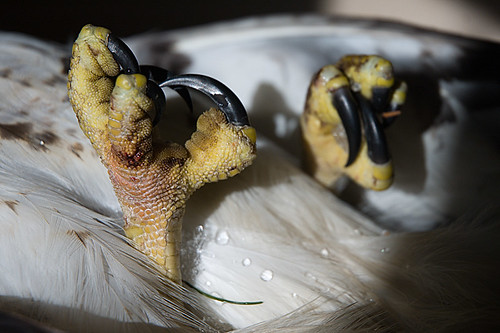
Red-tailed Hawk toes up close
Birds are recognized as being the “superb flyers” of the world. Although their wings are what helps them fly . . . . it is their feet and bill that help distinguish what ecological niche that hey live in. By studying their feet we can understand unusual behaviors and where they spend most hours of the day (tree, ground, water). We can look at the birds of prey who have armor protecting it from being bitten and sharp talons for grasping its prey. The grebe toes are lobed which will expand or contract as the bird swims or dives under water. Chickadees will uses its toes for grasp sunflower seed and then peck through the shell to get to the meat of the seed. Although there are many obvious features of the birds feet that helps it survive (as listed above) . . . I plan to discuss the 5 different toe arrangements that our birds have that help make those obvious features work! (more…)
My Irruption Northern Saw-whet Owl Year

First Northern Saw-whet Owl of the Season.
This year the Allegany State Park (Northern Saw-whet Owl) banding station was open for 28 nights and captured 83 different individuals with 90 total NSWO captures. We did not capture the hundreds of owls like the big migration sites but this stations numbers this season was significantly better than my previous three years of banding combined. The last two weeks in November resulted in very bad weather conditions (lake effect, strong winds and rain) which considerably reduced the number of net hours that the station typically operates. (more…)
Nature Haikus – by E

By Young Naturalist E
The grass was so soft
The shade was cool on my face
Birds are twittering
(more…)
Eagle’s and the Deer Carcasses

Bald Eagle
Sunday morning I received a phone call about some Eagles that were congregating around a decomposed deer here in Allegany State Park. The person who called wasn’t sure but he thought few Golden Eagles were mixed in with the Bald Eagles. That was enough for me to quickly finish uploading my Bonaparte’s Gull post and take off into the freezing rain to check out the situation. I was disappointed in not seeing any Golden’s but I did find a few cooperative Juvenal Bald Eagles to photograph.
(more…)
Bonaparte’s Gull Feeding [video]

A few Bonaparte’s Gulls
I was busy with a few personal things this weekend! But I did take a quick trip over to Dunkirk Harbor in search of some waterfowl! The Bonaparte’s Gull seemed to be the most dominate bird that I was able to locate but did find a few other special birds! (more…)
Pishing [video]
Pishing is when birders are “trying” to attract the attention of some little birdie by doing a “phhhhh phhhh – psst psst psst” sound. So many times I have found myself with a few non birding friends . . . then break out a few pish sounds after seeing a chickadee in the brush! My friends just don’t understand and I find myself explaining why I made those strange sounds and that “I am not going crazy”!

Black-capped Chickadee (Sep 2006).
Bullfrog Studio

Tree Swallows staying warm.
Most everyone will remember the above photo from this springs (Tree Swallow Acting Cute) post that I did. Sherri from London Ontario also saw this post and contacted me about using the picture for a painting she was creating. I was so honored that I inspired someone . . . . I said “YES YES YES, PLEASE!!” A few weeks later I received an email with a photo stating that she had finished the painting. I was soo happy that I told her whenever she had a webpage developed . . . . to PLEASE let me know so that I could help her promote it! This weekend she surprised me with a huge package from Canada that had a beautiful print of that Tree Swallow Painting! (more…)
Nature Haikus – Cardinal

By Young Naturalist C
Cardinal
Red as a cherry
Sitting on a low tree branch
Singing a sweet song (more…)


 Mon@rch's Nature Blog