
Unwanted Visitor at the Feeder
I found some Cardinal feathers scattered about this morning and just knew something wasn’t right. I quickly headed outside to investigate the crime scene and hoped it was a Coopers Hawk or even one of the Screech Owls that made the kill! But these were mammal track left in the fresh snow. I would have settled with some fisher or even fox tracks but these were obviously cat tracks! Hmm, CSI-Tom followed the feral cat tracks to its hiding spot and you have no idea how bad I scared it away. I only wish I could have barrowed Zick’s Chet or even Mary’s Chloe to help with my cat problem!! But, it came down to removing the feeder, no seeds scattered about and blocking its hiding spot. I am now bird less at my home bird feeder and I am amazed at how quickly the birds learn that there isn’t any food around (or that a predator is around). Lucky I still have my birds at my window feeder (on the second floor) to keep me entertained.

Photo of birds from this weekend before I took everything down.
Then on my way home from grocery store; I happen to see a fox running away with something in its mouth! Is it bad that I wished it was the feral cat? Hard to tell under the moon light but looked like a meadow vole or something else that size. I have to appreciate the food chain but did it have to be one of my Cardinals?
Day of downloading!
Yesterday my virus checking software became outdated and so I needed to spend some time today shopping for a new package! I realized that the cost for the 3 computer update package (with more options that what I had before) is cheaper than just renewing the older 2 computer package which I previously owned. You guessed it; I spent all evening downloading the new package for 2 of my 3 computers and I should finish with the 3rd computer sometime tomorrow. I only wish that DSL was an option for me (I live in a town of 28 people which I guess isn’t big enough for the phone company to bring in DSL)!! The satellite internet has too much of a startup cost and I have seriously thought about giving the cellular broadband a try for the laptop and continuing using the dial-up for the desktop! Anyone use the cellular broadband before?? They say it is just as fast as DSL!! Anyways, I have dial-up and spend more hours uploading or downloading than I have time for comments on so many of my friends photostreams or blogs!!
I figured this would be a good day for a little computer house cleaning; so 20 gig’s of raw photos were transferred over to my external hard drive. After virus scans, data transfer and defragging of just 2 of my computers, I am computer screened out and going to make time for bed (after watching hero’s)! Night everyone and don’t let the bed bugs bite!
Snowboarding
Today I was enjoying the beautiful outside weather doing nothing nature related (sorry nature blog friends). I decided to take my banding assistant snowboarding at one of our local ski resorts here in Western New York!! Probably one of my best snowboarding days that I have had in a “VERY LONG TIME”!! I am very tired after a very long day; so let me leave you with a few pictures from the day!!


I promice to catch up on everyone’s photostream and blogs here soon!
Nuthatch Fun Today
This White-breasted Nuthatch was teasing me all day with opening seeds in my window feeder. I happen to pull out my point-and-shoot camera and captured this mini video clip. It would take the seed, place it in the crack and chip away at the shell to open the seed. Yes – my windows are dirty.
I am extremely happy that blip.tv has finally worked out the code for adding video clips to wordpress blogs!!! Expect many more fun video clips from me here in the near future!
BIRD BANDING NEWS FOR THE DAY

Today I recaptured a male Red-breasted Nuthatch who I had first banded on the 5th of October 2005 (I have caught this guy a few times now). I have 5 or 6 Red-breasted Nuthatch who have been banded around the office but I seriously think this little guy probably visits my window feeder more than any other of those nuthatches. I always love watching him climb up and down the window frame.
Where do birds sleep at night?
On numerous occasions I have always wondered where all of my favorite birdies end up roosting at night? I can remember a few occasions which I have actually found such birds trying to spend their evening sleeping! Of course I always seem to agitate them and then find myself feeling bad that I somehow had to inconvenience them. For example; you have those nesting birds like the American Robin who always seem to settle on that perfect location right next to the main door. During the day they will flush the nest with any attempt to approaching the door but at night they will lay very low and only flush when approached too close.

During the winter months some species will obviously make their wintering roost site noticeable by roosting together in one large group (but rarely do we see them actually sleeping). The most typical example is when the American Crows flying many miles from their wintering territories to this one specific tree in someone’s backyard. It is absolutely breathtaking to see so many crows filing to these specific trees and then together move over to their roosting trees. These roosts have been known to scare neighborhoods by their strange grouping behavior. I can also remember those sounds made by thousands of European Starlings congregating together in that one particular bridge that I walked across each day. Then on that one precise second near sunset; every starling will instantly stopped vocalizing and you hear absolute silence.

Then you have those cavity species that will spend their evening roosting in trees like the Eastern Screech Owl or Eastern Bluebird. These birds are trying to avoid the elements of the weather and there are some individuals who might use these same holes for nesting sites during the summer months. I am sad to say that I have found numerous tree swallows smothered on the bottom of bluebird box after a cold spell approached. These birds were over stacked in the box while trying to use their body heat to stay warm. Those individuals on the bottom of the box had too many birds stacked on top of them and lost their life. Lucky this doesn’t happen on a regular basis.

This weekend I happen to come across an unusual encounter that I never expected to uncover. I saw this goldfinch flying towards the house while picking up my kitties food plates. This goldfinch was climbing in-between a 3 inch gap around the foundation of the house and some melted snow. It then climbed out of this crack and into an area that I couldn’t see from the window. I had just assumed this little fluff ball was searching for some food just before dusk (but something wasn’t right). I then decided to put on my boots and go investigate what this bird was getting into! I thought maybe it had found some stone flies or something else that was hidden in there. But, I never expected to find this goldfinch with its head tucked under its wing trying to sleep. It was cold so I assume this little birdie was trying to find a safe sheltered spot to keep out of the elements of the weather. I probably should have tried to photograph it but it was dark and some times we need to focus on the birdies best interest!!

This evening we are expecting this to be our coldest night of the year with the wind-chills being anywhere from -10° to -20°F. I wonder where my many birdie friends will be hiding this evening with such cold temperatures approaching. I do anticipate them making an early rise and starting to fatten up with my sunflower seeds.
Update: In Feb I found where a songbird had roosted for the night and I captured a photo of it!
Cat and Dog Act Gone Bad!
This isn’t my typical nature post but this is worth changing everything around for the day! My mother continues to be tested by her two adopted kids teaming up together and causing nonstop trouble. I received this phone call from her telling me about how this most recent event went bad for everyone.

Supposedly the dog decided that it was too cold outside and left a stinky treat for my mother on the kitchen floor! Upset with the dog, she yelled at him and cleaned up after it. Because it had stunk so bad, she decided to light 3 candles to help mask the horrific odor. Of course the cat had to investigate the crime scene after hearing her partner in crime had been yelled at (as she always does).

My mother continued telling me how she was running around trying to get ready for a funeral that she was about to attend. While running around the house and head outside to start her car; she happened to notice 4 flames over in the kitchen. With motherly instincts she realized that the cat’s tail was on fire. You have to hear how my mother explains it but there sat the cat with no clue that she had just placed her tail in the wrong location. Mother now needed to rescue her, ASAP!
Of course my mother freaked out (as would anyone finding their babies on fire) and smothered the flame by placing the closest towel over the cat’s tail. Being startled by all the excitement the cat took off hiding in a location which made it impossible for my mother to check to see if she had been burned.

Of course the cat is perfectly fine with only shorter hairs on her tail now. We continued to discuss how lucky the cat was that those huge flames were seen just as the event happened. We could only imagine what would have happened if the cat got startled while on fire and hid somewhere!! She could have burned down the whole house, curtains or even one of the couches. She is so luck that she didn’t get seriously burned which wouldn’t have been good.
So, not only did the house stink from the dog, it now smelled like burnt cat hair. MOM – I know you are reading this! PLEASE place your candles in locations which the cat will not be sticking her tail or whiskers in!!
time for work or time for play?

This weekend I spent numerous hours working on my end-of-the-year reports and can you believe that I am still behind on my PowerPoint slide show? This tardiness is partially due to parking myself next to the window entering my endless data into the computer. Of course I was watching the bird activity at the feeder’s more than typing. I was amazed at the nonstop lake effect dumping on us and I have decided that it is officially the start of winter (which finally brought out the birds). Although winter arrived late this year; I am just starting to see true signs of spring with numerous species of birds beginning to behave differently.

The entire day I watched two pairs of Northern Cardinals showing continuously agonistic behavior between each other. I still think that they only had a few opportunities to eat a few seeds before another cardinal would chase it away. It appears that the territories of the Cardinal have already been established and I think my feeder is the no fly zone between these two pairs.

I also noticed that the Dark-eyed Junco’s were more frequently singing and could this be the start of pair bonding? It is still quite a few months until they begin sitting on eggs but it is wonderful to hear those junco trills again after a long quiet fall/winter. I plan on continuing to watch all the birds at my feeders and smile every time those cute little chickadee’s tell the females “cheeeeese….burg..ger”
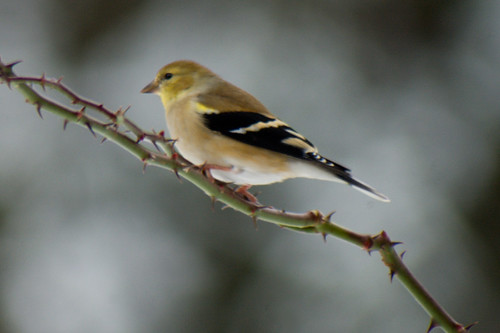
I will continue working on my PowerPoint slide show and then start working on more year end reports for 2006 (ugg). Just someday I can get back to schedule on updating my blog on a daily basis and spend more time taking pictures of our favorite fluff balls. Sunday you can expect me taking advantage of this fresh snow going snowboarding at one of the resorts for the first time this season. I hope to try to do some cross country skiing tomorrow evening after work.

Shameless Self Promotion
Last Friday the lake effect snow parked itself over the Southern Tier (WNY) which resulted in probably more than 6 inches of fluffy white snow. Accidents were happening all over the place and it was decided that our Cattaraugus County Bird Club was going to cancel our meeting scheduled for that evening. Being stuck in the house with nothing to do, I decided work on a new blog that I have wanted to do for a while now called “birdQUIZ”!!

I then spent many hours this weekend working on some of my end of the year reports due any day now. Ok, behind because of flickr and my blog world that have been taking up much of my extra time that I have (which I did end up finishing the reports about 11pm last evening). But, I did find some time for a few pictures of some birdies at the feeder and have a few “feeder” stories that maybe I can get around to posting. I now need to focus my time on a PowerPoint program that I need to complete for the many birdclubs, nature study clubs, ect.. scheduled across the Southern Tier this spring. I promise to try to take some brakes and visit your blog or photostream here in the near future.
BTW:!! birdQUIZ isn’t a blog that I plan on updating daily but it is a place that I plan on including fun birdQUIZ pictures that I have taken from time to time. So, be sure to add it to your RSS feed for any updates that I do. Check it out at http://birdquiz.wordpress.com.
Kenn Kauffman Speaking at RTPI
Great news everyone! Kenn Kaufman has been finally schedule to speak for the Roger Tory Peterson Institute distinguished speaker series on the 28th of February 2007. The lecture will be held over at the Stanley Weeks Theater on the campus of Jamestown Community College (is located at 525 Falconer Street, Jamestown, NY for those doing map quest).

Kenn Kaufman will introduce his new book, “A Field Guide to the Insects” and I anticipate him doing a wonderful slide program related to insects. I just learned from his website that this new insect guide has been illustrated with over 2,350 digitally enhanced images and they are planning on setting a new standard with detailed coverage maps. I can’t wait to see this book because I absolutely love how the butterfly guide turned out.
I have had an opportunity to hear Kenn speak twice before and every time he did a amazing job! I can’t wait to hear what he has to tell us again next month regarding the insects in his new book. Price for this event is $5 for member and $7 for non members. For more info you can contact the Roger Tory Peterson Institute at 716-665-2473 or on the web at http://www.rtpi.org.
Do turkeys smile?

I might be a Tom but I am no Turkey!
Here is looking at you my blogging and flickr friends.

Turkey Banding
Today I helped the NYS Department of Environmental Conservation (DEC) band Wild Turkeys here in Allegany State Park. What a perfect way to start the DEC and National Wild Turkey Federation’s second season by catching, banding and releasing 7 Turkeys. The DEC teams will continue to band birds across the New York State and collect information on our Wild Turkey populations.

I quickly headed down to the banding site after learning that I was given the ok to join the DEC team for the day. Once I arrived the crew had just finished setting everything up and it was now time to wait for the birds to show up. This was probably the coldest day of the year and I feel so sorry for that biologist who was stuck in that very cold blind waiting for their arrival. I decided to sit in my warm truck just down the road waiting for the his go-ahead that the birds have been caught and everything is clear.
I first found myself chatting with everyone ……. then trying to stay warm in the truck …… eating a little …… looking through the binoculars for any possible birds moving through…….. playing with the radio ……. turning on the heater again …….. playing with my cell phone …… and then a few hours later we got those 5 words that I can still remember!! “Radio silence we have birds!!” Did he just say that he can see birds out there? Everyone started to get excited and then we saw that very large pooof of smoke from the large rocket nets.


Supposedly this flock of Turkey arrived from the forest edge and then ran directly towards the cracked corn as if they were racing to see who would make it there first. It was only a matter of minutes until all the birds were on the target and the trigger was set off sending the rocket net directly over the birds. Quickly everyone at the waiting point took off in their trucks to assist in the banding of the captured Turkeys!!

For as many times that I have seen turkey up close, I found myself dumbfounded by how colorful they really are. Of course these colors can not be compared to the many songbirds that I band like the Yellow Warblers, Scarlet Tanagers or even the Indio Buntings!! But for an ugly bird like the Wild Turkey, they surely have such a spectacular blue, red coloring in their head and even those glossy green feathers on them just made me say “wow look at how beautiful they are”!!


Yes, let me tell you how hard it was to focus on preparing these birds for their removal from the net into their holding box. Each bird was banded one at a time with two metal bands placed around their legs. This allows each bird to be tracked individually like I do with my owls and songbirds.

To my excitement the team gave me an opportunity to band my very first Turkey with one of their bands!! As most know, I am currently a federal and state permitted licensed bird bander and I have handled hundreds of species of birds. My permits specifically say “all species except hummingbirds, gamebirds and endangered species. Wild Turkey are considered game birds and I know that I could have never dreamed of having an opportunity to band such a unique bird like the turkey. No doubt that I soaked up every second of the day and took a bazillion pictures.

We released these amazingly large birds as one group so that the flock would stay together (see me on the far left)!! There is no doubt that each one of these birds looked like flying bowling balls trying to make their quick getaway! This is just another winter day for a naturalist here in Allegany State Park.
problems with my furnace
Some reason I needed to turn up my furnace because of colder temperatures this evening….

…..or could it be because Phoebe is blocking the floor vent??
Winter Beaver Activity

Typically this time of the year the water is covered over with a thick layer of ice and snow. Little work is done by the beavers while the females are preparing to give birth. I noticed with the above average temperatures this year that the beavers have been putting in some overtime doing what they do best. I noticed since my last visit last fall that they have been enlarging their dams, adding to their food storage and improving their lodge.


It is so hard to believe that these dams are built entirely by the beavers. The picture on the left shows their main dams that’s just over 6 feet in height. Since the fall these guys have added an additional 2 feet to this dam and it is unbelievable how much water they are currently backing up. The second picture shows one of their reservoirs just down stream that they built to give the beavers more access to their food. They need to back up the water with these dams to providing protection from predators, ability to float logs back to their lodge and soften up the mud which helps them build everything up better.

During the fall months the beavers are very busy adding sticks to their food storage stacks to feed on during the winter months. I was shocked to find this food storage larger than I normally find this time of the year. If you look at this picture above you will see their typical way the beaver store the family’s food storage piles. This gives the beaver access to their food when the water is frozen over and limited to just their pond. Then they can swim under the ice to their food storage and bring the sticks back to the lodge to eat.

As the water level rises by increasing the height of the dam these beaver will continue to work on the lodge. They will add more mud and sticks to the outside of the lodge but then inside the lodge remove sticks from the top to add it to the lodge’s floor. It is a perfect way of building the lodge up to the needed size for the family living in it.
These beaver dazzle me every time that I visit them with their ability to do amazing work with sticks and mud.
Waterfowl Survey
Today I participated in the NYS DEC / NYSOA annual waterfowl survey. Each January a quarter of a million ducks are counted across New York State by bird clubs, state officials and your average birder. While out looking for ducks, we also participated in the National Winter Bald Eagle Survey that is conducted at the same time each year. The results of these two surveys will help determine the long-term monitoring of waterfowl and Eagle populations within New York State during the winter months.

Today was our target date for the waterfowl survey and the weather man wasn’t predicting the best of weather. There were predictions of freezing rain and lucky the whole morning the temps stayed above 36° F. But, we did have continued rain the whole day which made visibility extremely tough (and not great photos). I felt that the Eagles and Ducks were tucked in very tightly which resulted in our need to work harder in finding great birds.
|
2006 |
2007 |
|
| Bald Eagle |
8 |
1 |
| Canada Goose |
125 |
185 |
| Mallard |
89 |
96 |
| Black Duck |
7 |
3 |
| Common Merganser |
26 |
46 |
| Hooded Merganser |
2 |
3 |
| Bufflehead |
2 |
|
| Common Goldeneye |
|
1 |
| Long-tailed Duck |
|
1 |
| TOTAL DUCKS |
259 |
336 |
We had a total of 29 species observed (except Tim & Mike who heard a Titmouse which I missed because I was a little behind arriving). Highlights included the Northern Shrike (see photo below), Common Raven (displaying), American Coot, Long-tailed Duck and Common Goldeneye.

I am off to bed after this long day making me totally exhausted.
A few of my bird feeders

I got this squirrel proof feeder three years ago after my old barn feeder was chewed open by a Gray Squirrel. It didn’t take long before the squirrels tried every trick in book to steal those seeds from me. It was hilarious watching them with their continued failed attempts and I think the squirrels have finally given up trying. But, it didn’t take long before I learned that the feeder was not Raccoon or even Black Bear proof. Now I take the feeder down each night and place it back up in the morning. This is a wonderful bird feeder which I would recommend to anyone that has problems with Squirrels!

This is a lean-to feeder which allows birds to hide under it when eating their seeds. It was made by some friends who made it for me after I complemented how much I liked theirs. I have found that the sparrows, chickadees and dove species are the most commonly found birds using it.

This shelter allows the birds a safer location to feed from predators like the Sharp-shinned or Coopers Hawk.
Fancher Swimming Pool
Allegany State Park – History Flashback

The historic Fancher swimming pool was first opened to the public during the summer of 1926, which measured 40 x 100 feet.

During the spring of 1934 the Fancher pool was replaced by a larger concrete pool (50’ x 100’) built by the Civilian Conservation Corps. The funding for the new pool came from the late Senator Albert T. Fancher who passed away on the 30th of July 1930. Senator Fancher was one of the main people who helped develop the park in the early 1920’s.

This pool is always remember by its freezing cold temperatures, its size and socializing destination point for many of the campers, locals and employees. The picture below is just one of the numerous post cards which focused on people swimming in the Fancher pool.

I have been told that some of the reasons the beach was closed was due to a newer beach being developed over on Quaker Lake, failure to be able to repair cracks and that the park couldn’t keep water in it fast enough. It was last used Labor Day weekend in September 1981. It was finally demolished and filled up with gravel during September 1985. This pool is the currently location of the Fancher Bath House over on the Quaker Side of Allegany State Park, NY.

If you remember swimming in this pool, please feel free to add comments about some of your memories. I will be adding posts from time to time on Allegany State Park’s historic flashbacks. These are historic pictures from Allegany State Park’s archives (I do not know the dates of these pictures).
Downy Woodpecker

Been busy the past two evenings to post anything on the blog! So, I am just going to post this picture of a Downy Woodpecker which I photographed today during my lunch break!
Can birds learn?
Now you can officially accuse me of bring my nature studies into the office!! It started two summers ago when I placed a hummingbird feeder just outside my office window. Quickly these little green birdies started dazzling everyone by there charm and beauty. You never knew when someone was just outside my window taking pictures or video taping the 10 or so hummingbirds fighting for that perfect perch. Ultimately good things always come to an end and this happened when the hummingbirds decided to make their migration south for the winter. 
I found myself with a desire to bring nature back to the office again. Sunflower seeds were an excellent tool for inviting these birds back to my office and keeping me entertained. Birds like the Black-capped Chickadee, American Goldfinch, White-breasted Nuthatch, Red-breasted Nuthatch, Tufted Titmouse and Dark Eyed Junco are now regular visitors of mine. But, who would have expected birds like the Pine Siskin, Downy Woodpecker or even the Purple Finch to make numerous occurrences in my office window! Last year I even had friends from Buffalo make the hour trip south for the “possibility” of seeing an Evening Grosbeaks in my office window!!
You wonder how these unusual visitors are able to learn where I have placed a small pile of sunflower seeds in an unusual location like a window frame on the 2nd floor? Well, those nosy chickadees arrived within the first day and probably were investigating the disappearance of the hummingbird feeders (they must have known that this was a bird friendly window). Other species started visiting the window after learning that somewhere these chickadees were getting sunflower seeds. The learning process didn’t stop here; believe me when I tell you it continues.
Towards the end of the season last year I started to hear some knocking sounds. I turned around and found this White-breasted Nuthatch doing something that I have never seen before.


The nuthatch would grab a seed and bring it over to the edge of the window. Then it would place it between the metal frame and wooded base of the window and …..

put its full body into cracking open the seed!!


After a few hits the nuthatch would pull the seed out and continue the process all over again (or until the bird got sick of having my face 2 feet from the window watching)! If the seed fell out, the nuthatch would drop instantly down (see its position) to catch the seed in mid air!!


Now, I would call this very clever of this nuthatch to have figured out how to crack open these seeds. Quickly those nosy chickadees learned that this nuthatch would leave leftovers in the frame which were already shelled from the seed. Soon those curious chickadee were also giving the window thing a try.

This year for the first time the Downy Woodpeckers started visiting the window!! Not one but I have identified three different individuals coming to my window (how do I know three?? One female was banded by me, another female is bandless and there is a bandless male coming around)!!


As you probably expected, these Downy Woodpeckers have also learned how to crack open their seeds from their “birding” piers!! I can’t help but visualizing that these birds had to sit in a class room (taught by the ovenbird) on “how to crack open a seed in Tom’s window”!! So, learning is something done by not only humans but by birds also! I would love to hear how others have noticed birds learning!!
Goofy Weather Goofy Animals

This year the El Niño weather in New York State has made this the most unusual winter than I can ever remember. It almost feels like a roller coaster with temperatures last week above average, this week average and then soon to be above average again next week. I have never experienced anything like this before and have started to wonder what effects this could have on our local animals?


You wouldn’t think that warm temperatures in January could affect our local butterfly communities this summer. Take a caterpillar that hatches from an egg in the early spring and takes advantage of the spring wildflowers, tree buds or even early leaf development. After constant warm temperatures in January the caterpillars could emerge extra early and now starve from not finding enough food. Numbers for that population could drop drastically overnight and take it numerous years before the population returns back to normal. Looking one step further, this could affect the migrant birds searching for food on their journey north, etc….


The Little Brown Bat (Myotis lucifugus) will winter in underground caves, sometimes hundreds of miles away from their nursery colonies. These nursery colonies are typically in buildings, hollow trees or even in bat boxes (which we have placed here in Allegany). While hibernating they will wake up every few weeks and fly around when warm near their wintering cave. So, how is this weather affecting Little Brown Bats?? Last Thursday I was asked to move this Little Brown who found itself in an unwanted location. We rarely find them in this area of the park until March at the earliest and I never expected to find this species here in January. They should be further south in Pennsylvania, but with warmer temperatures this year; they are able to survive closer to their nursery locations than they could in previous years. This could benefit the bats if temperatures stay good but if we get a cold spell it might make it harder for them to survive?? At this point it is hard to tell!
 Photo by flickr friend annkelliott so please be sure to visit her photostream! Thanks for permission to use this picture!
In the northern latitudes the Long-tailed Weasel will go through a color change from its basic brown with (whitish – yellow) on its belly to its alternate color phase of all white except a little black tip on its tail. Annkelliott told me this interesting fact when I emailed her for permission to use her picture. She said “I found it interesting to read that the reason the Long-tailed Weasel has a black tip on its tail is so that for example, a hawk, would see the dark tip and grab that instead of the body, allowing the Weasel to escape”. With that in mind, you have these bright white weasels running around with no snow on the ground!! Predators like hawks, owls or even the fox can now easily see this prey from a good distance and reduce its chances for survival.
Good or bad the El Niño year is part of the life cycle and animals have survived years like this before! While some species are benefiting from the warmer temperatures; some could have their cycle disrupted and lose their life. Currently we are under a snow advisory with 6 inches of snow expected tonight. I can’t believe that just last week the average low temperature was 33°F and the average high was 49.6°F.
Sunday Birding
Today I forced myself to get outside and do a little birding for a few hours. I only wished that the sun was around longer!! But, I did enjoy myself and had some great birds show up.


I started off tottering around Wolf Run trying to explore the work done by the beavers this winter. With a lack of birds I figured it was time to head over to the Allegheny River and try to locate some Bald Eagles. Quickly 5 Bald Eagles were located gathering around something dead on the waters edge. Trying to focus the spotting scope better, I felt the hair on the back of my neck start to raise …. then turned around with a juvenal Bald Eagle flying over me. Lighting made it difficult but I was able to get in a few shots in before the bird disappeared into the trees. While getting back into my truck I was dazzled by 4 American Robins taking turns feeding on some sumac. I have been wondering were all my orange bellied friends have been hiding this winter. It is amazing how you have no birds all day and then surprise!


Once I made it back to Allegany, I spend some time searching Quaker Lake for some waterfowl. I only located a small raft of Hooded Mergansers and unsuccessfully searched the 100+ starlings for other blackbird species. Birds continued to be very quite in the France Brook area and then I finally hit a jackpot. There was a stunning pair of Common Mergansers and a Great Blue Heron hanging out at one of the Beaver ponds. Might not have been the best birding day but I just enjoyed getting out hiking around (and away from the computer for a little while).


BIRDS – My 2006 Nature Checklist
 I decided to split up my 2006 Nature Checklist into 5 different categories; Butterflies & Skippers, Amphibians, Reptiles, Mammals and Birds! The birds are the next family of critters which I will be reporting on my findings here in 2006 in Western New York State. Since the list has 159 birds listed and so large, I decided to break it down to the 69 non-passerines and 90 passerines.


This has been such a fun year with the birds, I have NO idea where start and decided to leave everything up to the numerous pictures that I have taken! But, I would like to thank all of my volunteers and banding assistants who helped make this another successful year at the banding station.


Here is my list of non-passerines which I have listed in taxonomic order by common name (I would be happy to send you their Latin name for any species in question):
| 1. Canada Goose | 36. Red-shouldered Hawk |
| 2. Tundra Swan | 37. Broad-winged Hawk |
| 3. Woodduck | 38. Red-tailed Hawk |
| 4. Gadwall | 39. Rough-legged Hawk |
| 5. American Wigeon | 40. American Kestrel |
| 6. American Black Duck | 41. Merlin |
| 7. Mallard | 42. Peregrine Falcon |
| 8. Blue-winged Teal | 43. American Coot |
| 9. Northern Shoveler | 44. Killdeer |
| 10. Northern Pintail | 45. Greater Yellowlegs |
| 11. Green-winged Teal | 46. Spotted Sandpiper |
| 12. Ring-necked Duck | 47. Wilson’s Snipe |
| 13. Lesser Scaup | 48. American Woodcock |
| 14. Long-tailed Duck | 49. Bonaparte’s Gull |
| 15. Bufflehead | 50. Ring-billed Gull |
| 16. Common Goldeneye | 51. Herring Gull |
| 17. Hooded Merganser | 52. Great Black-backed Gull |
| 18. Common Merganser | 53. Rock Pigeon |
| 19. Red-breasted Merganser | 54. Mourning Dove |
| 20. Ring-necked Pheasant | 55. Black-billed Cuckoo |
| 21. Ruffed Grouse | 56. Yellow-billed Cuckoo |
| 22. Wild Turkey | 57. Eastern Screech Owl |
| 23. Common Loon | 58. Great Horned Owl |
| 24. Pied-billed Grebe | 59. Barred Owl |
| 25. Horned Grebe | 60. Northern Saw-whet Owl |
| 26. Red-necked Grebe | 61. Chimney Swift |
| 27. Double-creasted Cormorant | 62. Ruby-throated Hummingbird |
| 28. Great Blue Heron | 63. Belted Kingfisher |
| 29. Green Heron | 64. Red-bellied Woodpecker |
| 30. Turkey Vulture | 65. Yellow-bellied Sapsucker |
| 31. Osprey | 66. Downy Woodpecker |
| 32. Bald Eagle | 67. Hairy Woodpecker |
| 33. Sharp-shinned Hawk | 68. Northern Flicker |
| 34. Cooper’s Hawk | 69. Pileated Woodpecker |
| 35. Northern Goshawk | |
| . |


Here is my list of passerines which I have listed in taxonomic order by common name (I would be happy to send you their Latin name for any species in question):
| 70. Eastern Wood-pewee | 115. Magnolia Warbler |
| 71. Acadian Flycatcher | 116. Black-throated Blue Warbler |
| 72. Alder Flycatcher | 117. Yellow-rumped Warbler |
| 73. Willow Flycatcher | 118. Blackthroated Green Warbler |
| 74. Least Flycatcher | 119. Blackburnian Warbler |
| 75. Eastern Phoebe | 120. Yellow-throated Warbler |
| 76. Great Crested Flycatcher | 121. Pine Warbler |
| 77. Eastern Kingbird | 122. Prairie Warbler |
| 78. Northern Shrike | 123. Palm Warbler |
| 79. Blue-headed Vireo | 124. Blackpoll Warbler |
| 80. Red-eyed Vireo | 125. Cerulean Warbler |
| 81. Blue Jay | 126. Black-and-white Warbler |
| 82. American Crow | 127. American Redstart |
| 83. Common Raven | 128. Ovenbird |
| 84. Horned Lark | 129. Northern Waterthrush |
| 85. Tree Swallow | 130. Mourning Warbler |
| 86. Northern Rough-winged Swallow | 131. Common Yellowthroat |
| 87. Cliff Swallow | 132. Hooded Warbler |
| 88. Barn Swallow | 133. Canada Warbler |
| 89. Black-capped Chickadee | 134. Scarlet Tanager |
| 90. Tufted Titmouse | 135. Eastern Towhee |
| 91. Red-breasted Nuthatch | 136. American Tree Sparrow |
| 92. White-breasted Nuthatch | 137. Chipping Sparrow |
| 93. Brown Creeper | 138. Field Sparrow |
| 94. Carolina Wren | 139. Fox Sparrow |
| 95. House Wren | 140. Song Sparrow |
| 96. Winter Wren | 141. Swamp Sparrow |
| 97. Golden-crowned Kinglet | 142. White-throated Sparrow |
| 98. Ruby-crowned Kinglet | 143. White-crowned Sparrow |
| 99. Blue-gray Gnatcatcher | 144. Dark-eyed Junco |
| 100. Eastern Bluebird | 145. Northern Cardianl |
| 101. Veery | 146. Rose-breasted Grosbeak |
| 102. Gray-cheeked Thrush | 147. Indigo Bunting |
| 103. Swainson’s Thrush | 148. Bobolink |
| 104. Hermit Thrush | 149. Red-winged Blackbird |
| 105. Wood Thrush | 150. Eastern Meadowlark |
| 106. American Robin | 151. Common Grackle |
| 107. Gray Catbird | 152. Brown-headed Cowbird |
| 108. European Starling | 153. Baltimore Oriole |
| 109. Cedar Waxwing | 154. Purple Finch |
| 110. Blue-winged Warbler | 155. House Finch |
| 111. Nashville Warbler | 156. Pine Siskin |
| 112. Northern Parula | 157. American Goldfinch |
| 113. Yellow Warbler | 158. Evening Grosbeak |
| 114. Chestnut-sided Warbler | 159. House Sparrow |
| . |


I can’t wait to see what birds in 2007 will bring me.
MAMMALS – My 2006 Nature Checklist

I decided to split up my 2006 Nature Checklist into 5 different categories; Butterflies & Skippers, Amphibians, Reptiles, Mammals and Birds! The mammals are the next family of critters which I will be reporting on my findings here in 2006 in Western New York State. Most of these sightings are coming from mammals getting into my trash, destroying my banding nets or even trying to get into my house. But, on occasion I do come across those few individuals who are just remarkable in every way. I don’t plan on doing every species but here are just a few that I would like to share.


The most memorable mammals for the 2006 year was “marshmallow” the albino woodchuck. Without a doubt, marshmallow became the talk of Allegany and if not anything else, the most photographed mammal of the park this year. I always saw him drawing attention from our patrons who would have him approach while trying to having their picnic at the picnic grounds. He always would stick very close to the road and almost cause numerous accidents by individuals trying to get his picture! It was a sad day on the 11th of August when marshmallow ran into the road and was hit by a vehicle while marshmallow was trying to avoiding someone’s dog.


The bears obviously put on a show this year along with many other furry critters. Being able to visually identify the fisher with those strange screaming sounds at night was my most amazing find for the year. I have already decided that since I am unable to take its picture in 2006 that for 2007 I will be spending my time trying to record its vocalization. They have woken me out of a deep sleep numerous times this year and this time I will have the microphone always ready.


Raccoons are always fun to watch along with numerous deer that cross my path on a daily basis. Beavers being found in the window well are another unique situation that I never expected to be seen in 2006. Although, I didn’t identify any shrews or moles like in previous years. I also missed out in the Gray Fox and one of the Weasels which I occasionally find.
Here is my list of Mammals which I have listed in taxonomic order by common name (I would be happy to send you their Latin name for any species in question):
1. Eastern Chipmunk |
2. Northern Flying Squirrel |
3. Black Squirrel |
4. Gray Squirrel |
5. Fox Squirrel |
6. Red Squirrel |
7. Beaver |
8. Muskrat |
9. Porcupine |
10. Woodchuck |
11. Opossum |
12. Big Brown Bat |
13. Little Brown Bat |
14. Northern Long-eared Bat |
15. Black Bear |
16. Coyote |
17. Fisher |
18. Red Fox |
19. Mink |
20. Raccoon |
21. Eastern Striped Skunk |
22. White-tailed Deer |
23. Eastern Cottontail |
24. Deer Mouse |
25. House Mouse |
26. Meadow Jumping Mouse |
27. Meadow Vole |
28. White-footed Deer Mouse |
. |
I can’t wait to see what mammals in 2007 will bring me.
REPTILES – My 2006 Nature Checklist
I decided to split up my 2006 Nature Checklist into 5 different categories; Butterflies & Skippers, Amphibians, Reptiles, Mammals and Birds! Reptiles are the next family in my series of species that I have kept track of within Western New York State. I have also taken the Reptiles and split them up between Turtles (4) and Snakes (6).

Some turtle species like the Eastern Painted Turtle can be consistently found in the same area day after day. Then if you’re lucky you could find turtles which are more secretive and it then becomes blog worthy. Last spring I had one of these experiences with a snapping turtle that approached me while I was out in the water searching by flashlight for spring peepers. Suddenly I felt something hit my rubber boots and this large snapping turtle climbing over my foot. I quickly tried to grab it but within a blink of an eye it crawled under a clump of grass. I did my best to grab it but was out of reach and I did not want to loose any fingers. We had so much fun that night.


The next exciting day was on the 1st of June 2006 where I didn’t find one but two unusual turtle encounters. Earlier in the day we had a male Wood Turtle crossing one of the dirt roads here in Allegany. Each year I sometimes come across one or maybe two Wood Turtle here in Allegany. What was so exciting about this find was that this guy was in an area which I had never seen them in this area before. That wasn’t the highlight of the day, it came later heading into town to get some pizza. I found this female Snapper looking for a place to lay her eggs in the gravel. This Snapping Turtle was very laid back and surprisingly it allowed me to get very close for a few pictures! I quickly took a few shots and let her do her thing. I did return later in the evening to find that she had successfully crossed back across the road without any harm.


Then you have those unusual encounters where you find this strange thing stuck in the middle of the road (or bridge). In late July this happened to an Eastern Spiny Softshell and luckily a concerned individual safely removed it from being run over by passing vehicles. It happened to have gotten stuck in the middle of the bridge and couldn’t figure out how to get over the edge. You might wonder how I ended up getting involved; well this person placed this turtle into a bag and brought it to my office for me to identify for him (people bring me unusual presents all the time). Shocked by this unique find, I quickly knew what this funny looking turtle was a Softshell and that we needed to return it back to the lake. I found it amazing how quickly it dashed into the water once we released it.
Here is my list of Turtles which I have listed in taxonomic order by common name (I would be happy to send you their Latin name for any species in question):
| 1. Common Snapping Turtle | 3. Eastern Spiny Softshell |
| 2. Eastern Painted Turtle | 4. Wood Turtle |
| . |

This year I didn’t spent too much time looking for snakes and only really missed out on seeing the Eastern Milk Snake from my previous years checklist. The highlights this year had to have been seeing three Smooth Green Snakes. Typically I only find green’s squished on the road and rarely lucky enough to find them alive! While at the Audubon Nature Pilgrimage this year, Rex had two live ones that he had found (and let me hold one). Then in late June while leading a group of people into the Old Growth Forest we happen to find a Smooth Green in some of the vegetation. I think we also found a Garter that day and the walk quickly turned into a reptile talk. We released the snakes where we found them and continued back talking about forest ecology. It was one of those few times that I didn’t have my camera with me.


Regarding other species of snakes, the Northern Ring-neck Snake truly put on a show for me year. I found some tiny ones around the admin building and even found one while it was snowing out in October. I was successful this year in photographing a Northern Water Snake after numerous unsuccessful attempts throughout the summer. Common Garter snakes were just as common as always and can’t wait believe where they were being seen.
Here is my list of Snakes which I have listed in taxonomic order by common name (I would be happy to send you their Latin name for any species in question):
| 1. Northern Water Snake | 4. Eastern Garter Snake |
| 2. Brown Snake | 5. Northern Ring-neck Snake |
| 3. Red-bellied Snake | 6. E. Smooth Green Snake |
| . |

I can’t wait to see what reptiles in 2007 will bring me. Maybe even a Timber Rattlesnake??
AMPHIBIANS – My 2006 Nature Checklist
I decided to split up my 2006 Nature Checklist into 5 different categories; Butterflies & Skippers, Amphibians, Reptiles, Mammals and Birds! Amphibians are the next family in my series of species that I have kept track of within Western New York State. I have also taken the Amphibians and split them up between Salamanders (8) and Frogs (7).

This year I had hopes of finding a Hellbender or Long-tailed Salamander along the Allegany River Valley but just didn’t take the time to get out and find them. Maybe 2007 will bring me these two species as “lifer” yet alone 2007 Salamanders that I don’t normally find. I also didn’t take the time to head out to Audubon’s property to see any of the Four-toed Salamanders which I had done in years past.


The “Salamander Night” occurred on the 12th of March 2006 this year which is much earlier than I can ever remember in years past. There were no larger numbers of them migrating to the vernal pools this year but more scattered visits over the whole week (than just one night). If you have never heard of “Salamander Night”, it is the first “warm” rainy night in the spring where the Spotted Salamanders migrate to vernal pools to breed. Many other critters like Wood Frogs and Spring Peepers can also been seen on this big night as many of us naturalist brave the elements to assist these Salamanders in crossing the road’s (and not get squished).


Here is my list of Salamanders which I have listed in taxonomic order by common name (I would be happy to send you their Latin name for any species in question):
| 1. Red-spotted Newt | 5. Northern Slimy Salamander |
| 2. Northern Dusky Salamander | 6. Wehrle’s Salamander |
| 3. Allegany Dusky Salamander | 7. Spotted Salamander |
| 4. Red-backed Salamander | 8. Spring Salamander |

This was a wonderful year for me taking Frog pictures and I was able to capture all 7 species of frogs that I had seen this year! I was most proud of capturing my first ever “pictures” of a Bullfrog and Pickerel Frog. I wasn’t that successful in finding any Gray Treefrogs within the Allegany State Park area (the one species which I missed out on this year). I did see someone’s pet gray but they don’t count for my list! As most know, I have fallen in love with the Gray Treefrog ever since I first saw them in Michigan many years ago. Next years goal is finding this species here in the park (which they have been recorded vocalizing in years past). Expect the blog world to be woken up with my excitement when that happens!


Here is my list of Frogs which I have listed in taxonomic order by common name (I would be happy to send you their Latin name for any species in question):
| 1. American Toad | 5. Northern leopard Frog |
| 2. Spring Peeper | 6. Pickerel Frog |
| 3. Bullfrog | 7. Wood Frog |
| 4. Green Frog |


I can’t wait to see what amphibians in 2007 will bring me.


 Mon@rch's Nature Blog