
Nuthatch Fun Today
This White-breasted Nuthatch was teasing me all day with opening seeds in my window feeder. I happen to pull out my point-and-shoot camera and captured this mini video clip. It would take the seed, place it in the crack and chip away at the shell to open the seed. Yes – my windows are dirty.
I am extremely happy that blip.tv has finally worked out the code for adding video clips to wordpress blogs!!! Expect many more fun video clips from me here in the near future!
BIRD BANDING NEWS FOR THE DAY

Today I recaptured a male Red-breasted Nuthatch who I had first banded on the 5th of October 2005 (I have caught this guy a few times now). I have 5 or 6 Red-breasted Nuthatch who have been banded around the office but I seriously think this little guy probably visits my window feeder more than any other of those nuthatches. I always love watching him climb up and down the window frame.
Where do birds sleep at night?
On numerous occasions I have always wondered where all of my favorite birdies end up roosting at night? I can remember a few occasions which I have actually found such birds trying to spend their evening sleeping! Of course I always seem to agitate them and then find myself feeling bad that I somehow had to inconvenience them. For example; you have those nesting birds like the American Robin who always seem to settle on that perfect location right next to the main door. During the day they will flush the nest with any attempt to approaching the door but at night they will lay very low and only flush when approached too close.

During the winter months some species will obviously make their wintering roost site noticeable by roosting together in one large group (but rarely do we see them actually sleeping). The most typical example is when the American Crows flying many miles from their wintering territories to this one specific tree in someone’s backyard. It is absolutely breathtaking to see so many crows filing to these specific trees and then together move over to their roosting trees. These roosts have been known to scare neighborhoods by their strange grouping behavior. I can also remember those sounds made by thousands of European Starlings congregating together in that one particular bridge that I walked across each day. Then on that one precise second near sunset; every starling will instantly stopped vocalizing and you hear absolute silence.

Then you have those cavity species that will spend their evening roosting in trees like the Eastern Screech Owl or Eastern Bluebird. These birds are trying to avoid the elements of the weather and there are some individuals who might use these same holes for nesting sites during the summer months. I am sad to say that I have found numerous tree swallows smothered on the bottom of bluebird box after a cold spell approached. These birds were over stacked in the box while trying to use their body heat to stay warm. Those individuals on the bottom of the box had too many birds stacked on top of them and lost their life. Lucky this doesn’t happen on a regular basis.

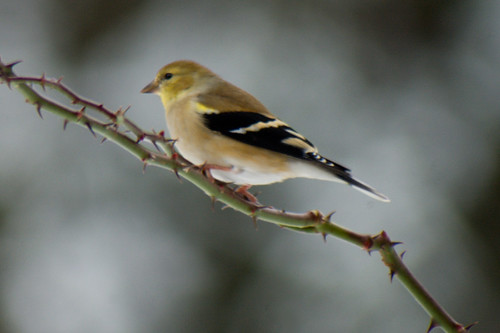
This weekend I happen to come across an unusual encounter that I never expected to uncover. I saw this goldfinch flying towards the house while picking up my kitties food plates. This goldfinch was climbing in-between a 3 inch gap around the foundation of the house and some melted snow. It then climbed out of this crack and into an area that I couldn’t see from the window. I had just assumed this little fluff ball was searching for some food just before dusk (but something wasn’t right). I then decided to put on my boots and go investigate what this bird was getting into! I thought maybe it had found some stone flies or something else that was hidden in there. But, I never expected to find this goldfinch with its head tucked under its wing trying to sleep. It was cold so I assume this little birdie was trying to find a safe sheltered spot to keep out of the elements of the weather. I probably should have tried to photograph it but it was dark and some times we need to focus on the birdies best interest!!

This evening we are expecting this to be our coldest night of the year with the wind-chills being anywhere from -10° to -20°F. I wonder where my many birdie friends will be hiding this evening with such cold temperatures approaching. I do anticipate them making an early rise and starting to fatten up with my sunflower seeds.
Update: In Feb I found where a songbird had roosted for the night and I captured a photo of it!
time for work or time for play?

This weekend I spent numerous hours working on my end-of-the-year reports and can you believe that I am still behind on my PowerPoint slide show? This tardiness is partially due to parking myself next to the window entering my endless data into the computer. Of course I was watching the bird activity at the feeder’s more than typing. I was amazed at the nonstop lake effect dumping on us and I have decided that it is officially the start of winter (which finally brought out the birds). Although winter arrived late this year; I am just starting to see true signs of spring with numerous species of birds beginning to behave differently.

The entire day I watched two pairs of Northern Cardinals showing continuously agonistic behavior between each other. I still think that they only had a few opportunities to eat a few seeds before another cardinal would chase it away. It appears that the territories of the Cardinal have already been established and I think my feeder is the no fly zone between these two pairs.

I also noticed that the Dark-eyed Junco’s were more frequently singing and could this be the start of pair bonding? It is still quite a few months until they begin sitting on eggs but it is wonderful to hear those junco trills again after a long quiet fall/winter. I plan on continuing to watch all the birds at my feeders and smile every time those cute little chickadee’s tell the females “cheeeeese….burg..ger”
I will continue working on my PowerPoint slide show and then start working on more year end reports for 2006 (ugg). Just someday I can get back to schedule on updating my blog on a daily basis and spend more time taking pictures of our favorite fluff balls. Sunday you can expect me taking advantage of this fresh snow going snowboarding at one of the resorts for the first time this season. I hope to try to do some cross country skiing tomorrow evening after work.

Shameless Self Promotion
Last Friday the lake effect snow parked itself over the Southern Tier (WNY) which resulted in probably more than 6 inches of fluffy white snow. Accidents were happening all over the place and it was decided that our Cattaraugus County Bird Club was going to cancel our meeting scheduled for that evening. Being stuck in the house with nothing to do, I decided work on a new blog that I have wanted to do for a while now called “birdQUIZ”!!

I then spent many hours this weekend working on some of my end of the year reports due any day now. Ok, behind because of flickr and my blog world that have been taking up much of my extra time that I have (which I did end up finishing the reports about 11pm last evening). But, I did find some time for a few pictures of some birdies at the feeder and have a few “feeder” stories that maybe I can get around to posting. I now need to focus my time on a PowerPoint program that I need to complete for the many birdclubs, nature study clubs, ect.. scheduled across the Southern Tier this spring. I promise to try to take some brakes and visit your blog or photostream here in the near future.
BTW:!! birdQUIZ isn’t a blog that I plan on updating daily but it is a place that I plan on including fun birdQUIZ pictures that I have taken from time to time. So, be sure to add it to your RSS feed for any updates that I do. Check it out at http://birdquiz.wordpress.com.
Do turkeys smile?

I might be a Tom but I am no Turkey!
Here is looking at you my blogging and flickr friends.

Turkey Banding
Today I helped the NYS Department of Environmental Conservation (DEC) band Wild Turkeys here in Allegany State Park. What a perfect way to start the DEC and National Wild Turkey Federation’s second season by catching, banding and releasing 7 Turkeys. The DEC teams will continue to band birds across the New York State and collect information on our Wild Turkey populations.

I quickly headed down to the banding site after learning that I was given the ok to join the DEC team for the day. Once I arrived the crew had just finished setting everything up and it was now time to wait for the birds to show up. This was probably the coldest day of the year and I feel so sorry for that biologist who was stuck in that very cold blind waiting for their arrival. I decided to sit in my warm truck just down the road waiting for the his go-ahead that the birds have been caught and everything is clear.
I first found myself chatting with everyone ……. then trying to stay warm in the truck …… eating a little …… looking through the binoculars for any possible birds moving through…….. playing with the radio ……. turning on the heater again …….. playing with my cell phone …… and then a few hours later we got those 5 words that I can still remember!! “Radio silence we have birds!!” Did he just say that he can see birds out there? Everyone started to get excited and then we saw that very large pooof of smoke from the large rocket nets.


Supposedly this flock of Turkey arrived from the forest edge and then ran directly towards the cracked corn as if they were racing to see who would make it there first. It was only a matter of minutes until all the birds were on the target and the trigger was set off sending the rocket net directly over the birds. Quickly everyone at the waiting point took off in their trucks to assist in the banding of the captured Turkeys!!

For as many times that I have seen turkey up close, I found myself dumbfounded by how colorful they really are. Of course these colors can not be compared to the many songbirds that I band like the Yellow Warblers, Scarlet Tanagers or even the Indio Buntings!! But for an ugly bird like the Wild Turkey, they surely have such a spectacular blue, red coloring in their head and even those glossy green feathers on them just made me say “wow look at how beautiful they are”!!


Yes, let me tell you how hard it was to focus on preparing these birds for their removal from the net into their holding box. Each bird was banded one at a time with two metal bands placed around their legs. This allows each bird to be tracked individually like I do with my owls and songbirds.

To my excitement the team gave me an opportunity to band my very first Turkey with one of their bands!! As most know, I am currently a federal and state permitted licensed bird bander and I have handled hundreds of species of birds. My permits specifically say “all species except hummingbirds, gamebirds and endangered species. Wild Turkey are considered game birds and I know that I could have never dreamed of having an opportunity to band such a unique bird like the turkey. No doubt that I soaked up every second of the day and took a bazillion pictures.

We released these amazingly large birds as one group so that the flock would stay together (see me on the far left)!! There is no doubt that each one of these birds looked like flying bowling balls trying to make their quick getaway! This is just another winter day for a naturalist here in Allegany State Park.
Waterfowl Survey
Today I participated in the NYS DEC / NYSOA annual waterfowl survey. Each January a quarter of a million ducks are counted across New York State by bird clubs, state officials and your average birder. While out looking for ducks, we also participated in the National Winter Bald Eagle Survey that is conducted at the same time each year. The results of these two surveys will help determine the long-term monitoring of waterfowl and Eagle populations within New York State during the winter months.

Today was our target date for the waterfowl survey and the weather man wasn’t predicting the best of weather. There were predictions of freezing rain and lucky the whole morning the temps stayed above 36° F. But, we did have continued rain the whole day which made visibility extremely tough (and not great photos). I felt that the Eagles and Ducks were tucked in very tightly which resulted in our need to work harder in finding great birds.
|
2006 |
2007 |
|
| Bald Eagle |
8 |
1 |
| Canada Goose |
125 |
185 |
| Mallard |
89 |
96 |
| Black Duck |
7 |
3 |
| Common Merganser |
26 |
46 |
| Hooded Merganser |
2 |
3 |
| Bufflehead |
2 |
|
| Common Goldeneye |
|
1 |
| Long-tailed Duck |
|
1 |
| TOTAL DUCKS |
259 |
336 |
We had a total of 29 species observed (except Tim & Mike who heard a Titmouse which I missed because I was a little behind arriving). Highlights included the Northern Shrike (see photo below), Common Raven (displaying), American Coot, Long-tailed Duck and Common Goldeneye.

I am off to bed after this long day making me totally exhausted.
A few of my bird feeders

I got this squirrel proof feeder three years ago after my old barn feeder was chewed open by a Gray Squirrel. It didn’t take long before the squirrels tried every trick in book to steal those seeds from me. It was hilarious watching them with their continued failed attempts and I think the squirrels have finally given up trying. But, it didn’t take long before I learned that the feeder was not Raccoon or even Black Bear proof. Now I take the feeder down each night and place it back up in the morning. This is a wonderful bird feeder which I would recommend to anyone that has problems with Squirrels!

This is a lean-to feeder which allows birds to hide under it when eating their seeds. It was made by some friends who made it for me after I complemented how much I liked theirs. I have found that the sparrows, chickadees and dove species are the most commonly found birds using it.

This shelter allows the birds a safer location to feed from predators like the Sharp-shinned or Coopers Hawk.
Downy Woodpecker

Been busy the past two evenings to post anything on the blog! So, I am just going to post this picture of a Downy Woodpecker which I photographed today during my lunch break!
Can birds learn?
Now you can officially accuse me of bring my nature studies into the office!! It started two summers ago when I placed a hummingbird feeder just outside my office window. Quickly these little green birdies started dazzling everyone by there charm and beauty. You never knew when someone was just outside my window taking pictures or video taping the 10 or so hummingbirds fighting for that perfect perch. Ultimately good things always come to an end and this happened when the hummingbirds decided to make their migration south for the winter. 
I found myself with a desire to bring nature back to the office again. Sunflower seeds were an excellent tool for inviting these birds back to my office and keeping me entertained. Birds like the Black-capped Chickadee, American Goldfinch, White-breasted Nuthatch, Red-breasted Nuthatch, Tufted Titmouse and Dark Eyed Junco are now regular visitors of mine. But, who would have expected birds like the Pine Siskin, Downy Woodpecker or even the Purple Finch to make numerous occurrences in my office window! Last year I even had friends from Buffalo make the hour trip south for the “possibility” of seeing an Evening Grosbeaks in my office window!!
You wonder how these unusual visitors are able to learn where I have placed a small pile of sunflower seeds in an unusual location like a window frame on the 2nd floor? Well, those nosy chickadees arrived within the first day and probably were investigating the disappearance of the hummingbird feeders (they must have known that this was a bird friendly window). Other species started visiting the window after learning that somewhere these chickadees were getting sunflower seeds. The learning process didn’t stop here; believe me when I tell you it continues.
Towards the end of the season last year I started to hear some knocking sounds. I turned around and found this White-breasted Nuthatch doing something that I have never seen before.


The nuthatch would grab a seed and bring it over to the edge of the window. Then it would place it between the metal frame and wooded base of the window and …..

put its full body into cracking open the seed!!


After a few hits the nuthatch would pull the seed out and continue the process all over again (or until the bird got sick of having my face 2 feet from the window watching)! If the seed fell out, the nuthatch would drop instantly down (see its position) to catch the seed in mid air!!


Now, I would call this very clever of this nuthatch to have figured out how to crack open these seeds. Quickly those nosy chickadees learned that this nuthatch would leave leftovers in the frame which were already shelled from the seed. Soon those curious chickadee were also giving the window thing a try.

This year for the first time the Downy Woodpeckers started visiting the window!! Not one but I have identified three different individuals coming to my window (how do I know three?? One female was banded by me, another female is bandless and there is a bandless male coming around)!!


As you probably expected, these Downy Woodpeckers have also learned how to crack open their seeds from their “birding” piers!! I can’t help but visualizing that these birds had to sit in a class room (taught by the ovenbird) on “how to crack open a seed in Tom’s window”!! So, learning is something done by not only humans but by birds also! I would love to hear how others have noticed birds learning!!
Goofy Weather Goofy Animals

This year the El Niño weather in New York State has made this the most unusual winter than I can ever remember. It almost feels like a roller coaster with temperatures last week above average, this week average and then soon to be above average again next week. I have never experienced anything like this before and have started to wonder what effects this could have on our local animals?


You wouldn’t think that warm temperatures in January could affect our local butterfly communities this summer. Take a caterpillar that hatches from an egg in the early spring and takes advantage of the spring wildflowers, tree buds or even early leaf development. After constant warm temperatures in January the caterpillars could emerge extra early and now starve from not finding enough food. Numbers for that population could drop drastically overnight and take it numerous years before the population returns back to normal. Looking one step further, this could affect the migrant birds searching for food on their journey north, etc….


The Little Brown Bat (Myotis lucifugus) will winter in underground caves, sometimes hundreds of miles away from their nursery colonies. These nursery colonies are typically in buildings, hollow trees or even in bat boxes (which we have placed here in Allegany). While hibernating they will wake up every few weeks and fly around when warm near their wintering cave. So, how is this weather affecting Little Brown Bats?? Last Thursday I was asked to move this Little Brown who found itself in an unwanted location. We rarely find them in this area of the park until March at the earliest and I never expected to find this species here in January. They should be further south in Pennsylvania, but with warmer temperatures this year; they are able to survive closer to their nursery locations than they could in previous years. This could benefit the bats if temperatures stay good but if we get a cold spell it might make it harder for them to survive?? At this point it is hard to tell!
 Photo by flickr friend annkelliott so please be sure to visit her photostream! Thanks for permission to use this picture!
In the northern latitudes the Long-tailed Weasel will go through a color change from its basic brown with (whitish – yellow) on its belly to its alternate color phase of all white except a little black tip on its tail. Annkelliott told me this interesting fact when I emailed her for permission to use her picture. She said “I found it interesting to read that the reason the Long-tailed Weasel has a black tip on its tail is so that for example, a hawk, would see the dark tip and grab that instead of the body, allowing the Weasel to escape”. With that in mind, you have these bright white weasels running around with no snow on the ground!! Predators like hawks, owls or even the fox can now easily see this prey from a good distance and reduce its chances for survival.
Good or bad the El Niño year is part of the life cycle and animals have survived years like this before! While some species are benefiting from the warmer temperatures; some could have their cycle disrupted and lose their life. Currently we are under a snow advisory with 6 inches of snow expected tonight. I can’t believe that just last week the average low temperature was 33°F and the average high was 49.6°F.
Sunday Birding
Today I forced myself to get outside and do a little birding for a few hours. I only wished that the sun was around longer!! But, I did enjoy myself and had some great birds show up.


I started off tottering around Wolf Run trying to explore the work done by the beavers this winter. With a lack of birds I figured it was time to head over to the Allegheny River and try to locate some Bald Eagles. Quickly 5 Bald Eagles were located gathering around something dead on the waters edge. Trying to focus the spotting scope better, I felt the hair on the back of my neck start to raise …. then turned around with a juvenal Bald Eagle flying over me. Lighting made it difficult but I was able to get in a few shots in before the bird disappeared into the trees. While getting back into my truck I was dazzled by 4 American Robins taking turns feeding on some sumac. I have been wondering were all my orange bellied friends have been hiding this winter. It is amazing how you have no birds all day and then surprise!


Once I made it back to Allegany, I spend some time searching Quaker Lake for some waterfowl. I only located a small raft of Hooded Mergansers and unsuccessfully searched the 100+ starlings for other blackbird species. Birds continued to be very quite in the France Brook area and then I finally hit a jackpot. There was a stunning pair of Common Mergansers and a Great Blue Heron hanging out at one of the Beaver ponds. Might not have been the best birding day but I just enjoyed getting out hiking around (and away from the computer for a little while).


BIRDS – My 2006 Nature Checklist
 I decided to split up my 2006 Nature Checklist into 5 different categories; Butterflies & Skippers, Amphibians, Reptiles, Mammals and Birds! The birds are the next family of critters which I will be reporting on my findings here in 2006 in Western New York State. Since the list has 159 birds listed and so large, I decided to break it down to the 69 non-passerines and 90 passerines.


This has been such a fun year with the birds, I have NO idea where start and decided to leave everything up to the numerous pictures that I have taken! But, I would like to thank all of my volunteers and banding assistants who helped make this another successful year at the banding station.


Here is my list of non-passerines which I have listed in taxonomic order by common name (I would be happy to send you their Latin name for any species in question):
| 1. Canada Goose | 36. Red-shouldered Hawk |
| 2. Tundra Swan | 37. Broad-winged Hawk |
| 3. Woodduck | 38. Red-tailed Hawk |
| 4. Gadwall | 39. Rough-legged Hawk |
| 5. American Wigeon | 40. American Kestrel |
| 6. American Black Duck | 41. Merlin |
| 7. Mallard | 42. Peregrine Falcon |
| 8. Blue-winged Teal | 43. American Coot |
| 9. Northern Shoveler | 44. Killdeer |
| 10. Northern Pintail | 45. Greater Yellowlegs |
| 11. Green-winged Teal | 46. Spotted Sandpiper |
| 12. Ring-necked Duck | 47. Wilson’s Snipe |
| 13. Lesser Scaup | 48. American Woodcock |
| 14. Long-tailed Duck | 49. Bonaparte’s Gull |
| 15. Bufflehead | 50. Ring-billed Gull |
| 16. Common Goldeneye | 51. Herring Gull |
| 17. Hooded Merganser | 52. Great Black-backed Gull |
| 18. Common Merganser | 53. Rock Pigeon |
| 19. Red-breasted Merganser | 54. Mourning Dove |
| 20. Ring-necked Pheasant | 55. Black-billed Cuckoo |
| 21. Ruffed Grouse | 56. Yellow-billed Cuckoo |
| 22. Wild Turkey | 57. Eastern Screech Owl |
| 23. Common Loon | 58. Great Horned Owl |
| 24. Pied-billed Grebe | 59. Barred Owl |
| 25. Horned Grebe | 60. Northern Saw-whet Owl |
| 26. Red-necked Grebe | 61. Chimney Swift |
| 27. Double-creasted Cormorant | 62. Ruby-throated Hummingbird |
| 28. Great Blue Heron | 63. Belted Kingfisher |
| 29. Green Heron | 64. Red-bellied Woodpecker |
| 30. Turkey Vulture | 65. Yellow-bellied Sapsucker |
| 31. Osprey | 66. Downy Woodpecker |
| 32. Bald Eagle | 67. Hairy Woodpecker |
| 33. Sharp-shinned Hawk | 68. Northern Flicker |
| 34. Cooper’s Hawk | 69. Pileated Woodpecker |
| 35. Northern Goshawk | |
| . |


Here is my list of passerines which I have listed in taxonomic order by common name (I would be happy to send you their Latin name for any species in question):
| 70. Eastern Wood-pewee | 115. Magnolia Warbler |
| 71. Acadian Flycatcher | 116. Black-throated Blue Warbler |
| 72. Alder Flycatcher | 117. Yellow-rumped Warbler |
| 73. Willow Flycatcher | 118. Blackthroated Green Warbler |
| 74. Least Flycatcher | 119. Blackburnian Warbler |
| 75. Eastern Phoebe | 120. Yellow-throated Warbler |
| 76. Great Crested Flycatcher | 121. Pine Warbler |
| 77. Eastern Kingbird | 122. Prairie Warbler |
| 78. Northern Shrike | 123. Palm Warbler |
| 79. Blue-headed Vireo | 124. Blackpoll Warbler |
| 80. Red-eyed Vireo | 125. Cerulean Warbler |
| 81. Blue Jay | 126. Black-and-white Warbler |
| 82. American Crow | 127. American Redstart |
| 83. Common Raven | 128. Ovenbird |
| 84. Horned Lark | 129. Northern Waterthrush |
| 85. Tree Swallow | 130. Mourning Warbler |
| 86. Northern Rough-winged Swallow | 131. Common Yellowthroat |
| 87. Cliff Swallow | 132. Hooded Warbler |
| 88. Barn Swallow | 133. Canada Warbler |
| 89. Black-capped Chickadee | 134. Scarlet Tanager |
| 90. Tufted Titmouse | 135. Eastern Towhee |
| 91. Red-breasted Nuthatch | 136. American Tree Sparrow |
| 92. White-breasted Nuthatch | 137. Chipping Sparrow |
| 93. Brown Creeper | 138. Field Sparrow |
| 94. Carolina Wren | 139. Fox Sparrow |
| 95. House Wren | 140. Song Sparrow |
| 96. Winter Wren | 141. Swamp Sparrow |
| 97. Golden-crowned Kinglet | 142. White-throated Sparrow |
| 98. Ruby-crowned Kinglet | 143. White-crowned Sparrow |
| 99. Blue-gray Gnatcatcher | 144. Dark-eyed Junco |
| 100. Eastern Bluebird | 145. Northern Cardianl |
| 101. Veery | 146. Rose-breasted Grosbeak |
| 102. Gray-cheeked Thrush | 147. Indigo Bunting |
| 103. Swainson’s Thrush | 148. Bobolink |
| 104. Hermit Thrush | 149. Red-winged Blackbird |
| 105. Wood Thrush | 150. Eastern Meadowlark |
| 106. American Robin | 151. Common Grackle |
| 107. Gray Catbird | 152. Brown-headed Cowbird |
| 108. European Starling | 153. Baltimore Oriole |
| 109. Cedar Waxwing | 154. Purple Finch |
| 110. Blue-winged Warbler | 155. House Finch |
| 111. Nashville Warbler | 156. Pine Siskin |
| 112. Northern Parula | 157. American Goldfinch |
| 113. Yellow Warbler | 158. Evening Grosbeak |
| 114. Chestnut-sided Warbler | 159. House Sparrow |
| . |


I can’t wait to see what birds in 2007 will bring me.
American Coot

To someone that doesn’t normally get to see the American Coot, I truly enjoyed myself watching them as if they were a rare bird! Of course, they are not that rare and when they do show up they don’t let me to photograph them like what I captured here. Lucky we found two individuals that let us sneak up on them and watch them feeding around the docks. It was soo cute; they were slowly bopping up and down in the water looking for some vegetation to eat! Sibley stated that they floated like a cork! I could see that for sure with these birds!

When I first saw them, I couldn’t figure out what the heck they were doing! Then I realized that they were picking the vegetation growing along the dock’s edge! But, not all of the coots that we saw were feeding on the docks edge. A good majority of them were feeding on some kind of vegetation (probably seaweed of some kind) or maybe some small fish. I just couldn’t get enough of these American “cutes” and I just had to make them their own post!


Such an interesting bird, wish they would come inland more!
Lake Erie Birding
 As, I had mentioned in my previous post! I spent the day with Jordon birding along Lake Erie in Chautauqua County, NY. I wanted to try to add a few birds to my 2006 year list. We had lots of fun trying to identify many duck spots that even the spotting scopes couldn’t help bring in closer. Lighting wasn’t the best but we did get a few good looks of some waterfowl that cooperated. Highlight of the day had to be two Red-necked Grebes that we had at one of our pull over areas.


We also enjoyed watching the Hooded Mergansers and American Coots feeding in-between the docks. It was nice to closely approach them without too much startling. We also came across some Greater Scaup and A Belted Kingfisher around the dock area which I never expected to find.


Here is my list of birds that we saw which isn’t in any particular order.
Bufflehead – 16, Common Goldeneye – 12, Great Black-backed Gull – 52, Common Merganser – 14, Red Breasted Merganser – 5, *Red-necked Grebe – 2, Horned Grebe – 6, American Crow ~, Common Grackle – 1, Double-crested Cormorant – 82, Herring Gull ~, Ring-billed Gull ~, Mallard ~, Black Duck – 1, Canada Goose ~, Pied Billed Grebe – 4, *American Coot – 50, Hooded Merganser – 57, Belted Kingfisher – 1, Greater Scaup – 7,
* My first for my 2006 list and in a few days, the list starts all over again!
Great Black-backed Gull

It has been a few weeks since I have gone out and done some real birding. I ended up taking the day off of work and took this opportunity to have Jordon show me around to some of his favorite birding spots. So, today I was up along Lake Erie with the hopes of adding a few species to my 2006 year list(which I did do). I will post our results tomorrow once I get a chance to edit more photos.

The Great Black-backed Gull’s was a species that I have been dieing to photograph for some time and never expected to find some putting on a show for us. Luckily we found a few of these guys right along the road fighting over a fish. I figured they deserved their own posting and as you can see I was very happy with how these shots turned out.

They are easily identified by their black back and one of our largest gulls seen around the Great Lakes. They have a very deep voice and these guys made me wish I had my sound recording equipment on me to get a recording.


I am soo glad that I wasn’t that fish they kept on fighting over.
My 2006 blogging review of this site
There is always that one moment in your life when something happens and your life is turned upside down! This could be your first up close encounter of that colorful small bird. You then find yourself becoming a birdwatcher within a matter of seconds. You remember those brown streaks down its body as clearly and those mini sideburns on its head. That’s right “how could I have forgotten its bright yellow ball cap on its head”?? You’re then looking through a line up of birds in your new field guide trying to figure out what it could be? Well, this Chestnut-sided Warbler wasn’t the bird that started my new love of blogging but a Black Bear visiting my bird feeder is what did me in!

For as long as I live, I will never forget my heart pumping almost 100 miles per/hour and this bears trashy mildew smell following it (the original post can be seen HERE). Yes, I have come across bears on numerous occasions but this one encounter was very special! It was me and the bear eye-to-eye and I had never been so scared in my life! Luckily I was able to capture a few photos before my neighbors dog started barking.
This was a time period which I had started visiting some of my flickr friends blogs and something just clicked that this would be a great experience to share through a blog? I find myself 6 months after starting this blog and excited that this will be my 100th post here on “Mon@rch’s Nature Blog”. I can’t believe how quickly time has gone by and I never would have expected to have so much to say to everyone.
I guess this is the perfect opportunity to reflect on a few of my favorite post from 2006 which I think you should go back and revisit again (or visit for the first time).

Back in August we rescued this Beaver who somehow got trapped in one of the Administration Buildings window wells. This is something that I could have never imagined having to save but there is no doubt that this has to be my all time favorite post for 2006. To see more go to: Is that a …. Your kidding me …

My saddest post for 2006 would have to be the loss of “Marshmallow” the albino woodchuck who everyone in the park tried to see but still fell in love with. This poor little thing lost its life when given the option of challenging a dog or taking its chances with a vehicle. To see more go to: It’s not my fault that I am a mutant!

My most proud moment of 2006 was when the kids and I were able to complete our two day adventure backpacking along the North Country Trail. We started from my house and hiked to the kid’s parent’s campsite. To see more go to: Day 1 and Day 2

I think one of the most interesting discovery I had for 2006 was the young Woodturtle we found that had a broken shell. To be honest, that whole day was fun discovering wildflowers, herps, birds, ect… but this Woodturtle is a critter that I think about all the time. To see more go to: Young Woodturtle

There is no doubt that I banded many wonderful birds this season. I also had an amazing year banding the Northern Saw-whet Owls and documenting each day on this blog. But, I have to give this Barred Owl the award for my largest bird banded in 2006. To see more go to: An unusual visitor at the banding station

Lycopodium by Maxwell C. Wheat is such a wonderful poem and one that I have been thinking about using for Christmas for quite a while now. I have to give this post the award for the longest planned blog for 2006. Do expect more poems by Max to be posted here in 2007. To read the poem go to: Lycopodium
There were so many posts in this blog that I wanted to include but I needed to keep it down to only a few of my all time faves! So, please take the time to review the others from 2006 and I would love to hear which post were your favorites.
Might 2007 bring many wonderful things to blog and Happy New Year to everyone!
winter solstice triggers changes in the birds

In the Northern Hemisphere the Winter Solstice officially occurs on the 21 st of December at exactly 7:20pm EST. At this point the sun will reach the Tropic of Capricorn making this the shortest day of the year. Here in Allegany State Park, NY we will have just over 9 hours of sunlight which I plan on celebrating by catching up on my sleep. We will begin to increase daylight hours until the Summer Solstice on the 21 st of June when the sun reaches the Tropic of Cancer. That is when I will be celebrating with very little sleep due to looking for many birds and butterflies.
It shouldn’t be too long before the birds start courting each other and being their nesting. Yep, I said that the birds will begin nesting here soon! By mid to late January there will be Great Horned Owls sitting low in an old hawk nest or they could even be in a squirrel nest. Mid February you can expect our Bald Eagles to be busy adding sticks to their nest and then sitting low through numerous snowstorms that will hit us. Ravens will disappear in the top of a hemlock tree deep in the forest with only a few occurrences of that bone-stuck-in-their-throat sound. Once groundhogs day arrives many of our songbirds will show changes in their behaviors with their songs being a common occurrence. Red-shouldered Hawks will be displaying high in the sky and Bluejays will be tricking me with their mimicking of numerous hawk species. Once warblers arrive, most male birds will have their testosterone at their highest levels and territory lines will be laid out. O, how spring is my favorite time of the year!!
Summer Solstice will be here in no time and I will then be discussing their fledging of nestlings and preparation of migrating south for the winter. How time flies when having fun with the birds.
White-Blue Peacock

White-Blue Peacock, originally uploaded by chi liu.
Isn’t this an amazing photo of this half white and half blue peacock? Saw this today on flickr and thought this would be perfect to add to the blog! No photoshop was used on this bird, it is the real thing! Would love to hear what you think about it!
Sorry that I haven’t posted anything recently, I have been quite busy doing the holiday thing and currently my truck is being inspected, ect… gives me little time to travel around the park.
Regarding nature related things going on; Sunday December 17th, 2006 we had both Big Brown Bats and what looked like Northern Long-eared Bats still out and about. It was fun watching them flying up and down the road in search of insects. I would have expected them to be in hibernation already but with this mild winter…… I guess anything is possible! For sure this has been the latest in the year that I have seen any bats species flying around.
Last nights walk around the lake brought some fun activity with a Northern Cardinal. I took my Audubon squeakier with me and they came right up to me! Of course, too dark to try to take any pictures, so I just enjoyed the moment! Besides that, everything has been very quite outside.
Along the Allegheny River during the CBC
After working in section 3 during our Christmas Bird Count last Saturday, I ran into Tim starting the second part of his section along the Allegheny River. I was excited to join him and I just knew that being down along the river that I would be doubling my species (as I did).

We hiked through the riparian old field with hopes of waterfowl or anything else unusual!! Of course it was unusually quite with no birds!! Then, as we were getting closer to our vehicle we heard a flurry of birds! Hard to decide which way to look first – over there it’s a woodpecker! Quickly we identified it as a male Red-bellied Woodpecker – cool!! We were able to check off; 5 Black-capped Chickadee – 2 Blue Jay – White-breasted Nuthatch – Downy Woodpecker – 2 Hairy Woodpeckers!! Wonderful – there is not just one but a pair of Cardinals! It is about time that the birds started getting good!! Then, we come across another woodpecker! Isn’t that the Red-bellied?? We discuss how we saw it fly away – could it be the same bird?? Nope, female – red only on back side of its head! Another check – 2 Red-bellied Woodpeckers!
It is funny how within a matter of seconds we are finding all these birds together where we were hiking in very suitable habitat for an hour without a single peep. During the winter months, there are many birds that almost seem to follow the chickadees around as if they were the pied piper. Why might you ask? Hard to tell but these birds are working together as a team with each bird filling a different ecological nitch. As the nuthatch is looking under the bark, the chickadee is at the end of the branches and cardinals are feeding on the seeds on the ground – ect… It is easier to work together as a team than when by yourself! This can also be true as humans who have different skills. Next time you’re out birdwatching this winter, just check out the chickadees and I bet there will be other birds flying around with them.


As we changed directions along the Allegheny, we come across many other wonderful birds like the White-throated Sparrows, Tree Sparrows, Red-tailed Hawk, and even a Great Blue Heron! But, what I truly enjoyed was exploring this section of the river without 2 feet of snow on the ground. We saw many mussels on the river bottom and could have almost picked up this Bald Eagle bait (I think it’s a sucker) along the rivers edge. It was reinsuring this river system is doing so well after seeing all this out in the field after discussing the Upper Allegheny River Basin at the Nature Conservancy meeting last week.


While avoiding stepping on the numerous Skunk Cabbage plants poking out of the ground, we had a wonderful afternoon. Although the birds didn’t appear as we had anticipated but we saw a wonderful diversity of wildlife along the Allegheny River. I would love to see this area during the summer months.
365 days on flickr

I joined flickr one year ago and uploaded some butterfly pictures to a world which I never expected to change my life like it did. I have learned soo much from everyone and I have made such wonderful friends on the site. I helped Bird Mom in organizing camp flickr and attended some other flickr meets that have been scheduled. I have been encouraged through flickr to create this blog and share all my experiences with everyone. I started a few groups like herps and insects in the hand. So much has been learned by just looking at everyones pictures. I would like to thanks everyone for just being there for me when I need a smile. THANKS!
Pictures which made the top 500 on flickr’s explorer

1. Saying So Long for Another Season, 2. Waxwing when we use to have leaves!, 3. Herring Gulls riding the wind, 4. Northern Saw-whet Owl, 5. darner species, 6. running away newt, 7. Red House Creek, 8. a Happy Red Squirrel,
9. Summer Velvet, 10. Trouble Bears, 11. summer azure, 12. mamma and the kids, 13. cecropia moth, 14. big campfire, 15. Along the side of the road!, 16. Office Visitor,
17. Sharp-shinned Hawk, 18. can I help you with something, 19. woodfrog eggs, 20. an older monarch photo, 21. Snowdrops in the Rain, 22. Northern Saw-whet Owl, 23. Mini Me!, 24. Scotish Highland Cow,
25. Red House Lake, 26. A Summer Millipede, 27. Viceroy, 28. Gray Comma Looking a little camouflage!, 29. NSWO, 30. White Admiral
Did the Christmas Bird Count Today
Today I participated in the 57th Saint Bonaventure Christmas Bird Count or also known as the 107th Audubon Count. Tonight the group reflected the past 57 years in counting birds in this circle. I learned that Dr. Eaton has participated in every St. Bonaventure count since he started it back in 1950. He told us that “back in the early years that they would be happy with 20 species of birds”. Over time they slowly increased their numbers which currently averages around 50 species. With low numbers this year we found ourselves discussing better optics and other ways to increase our numbers (like taking a boat down the Allegheny River).
My day started today in section 3 with an American Kestrel stirring up 70 European Starlings. I then hiked through the woods for an hour with only a handful of chickadees. Hmm, so is this what the day is going to be like?? Quickly I learned that this year we needed to work for our birds but working hard would result in good birds!! I did have many new finds for my section and satisfied in the total numbers of birds that I observed.

The Cattaraugus County Bird Club as a team recorded 40 species and individually counted 3026 different birds. I was able to see 28 of those 40 species in 2 of the 6 sections within the circle. These numbers are much lower than our typical 50 species days from years past. I would have to believe that these numbers are low because of the unusual warmer temperatures and I can’t wait to see how other circles have or will do this season.

In between counting birdies, I did find many photographing opportunities but for most of the morning I was having all kinds of problems with my camera. Ever try taking pictures with a 400mm lens with it manually set on F22 ? When the sun came out, most everything was strongly washed out due to the auto ISO requiring it to be set on 1600. It wasn’t until I completed section 3 and move over to section 1 that I realized my F stops were so high!! I missed some very close encounters of a Golden Crowned Kinglet showing its colors on his head. I also missed out on numerous Sparrows and Chickadees that came close to investigating my pishing. The only picture which I would say was acceptable to publish was this Common Merganser. A good rule of thumb is once your camera is working again, the birds will not cooperate like this White-breasted Nuthatch mooning us.

I will include all 28 species that I saw in the comments box. I can’t wait to see how everyone else did.
St Bonaventure Christmas Bird Count

This Black-capped Chickadee is counting its seeds at the feeder! Tomorrow I will be counting the birds during the 107th Christmas Bird Count in the Saint Bonaventure circle here in Cattaraugus County, NY. I have been doing this circle since 1994 and been doing section 3 for the past 8 maybe 9 years now. After the count we all have dinner together to discuss who had the best birds of the day.
If you would like to participate in a count near you, please visit this “Audubon CBC” site. Stay tuned to hear what birds we end up finding in this circle.
winter blues
A good birding friend once told me that he “makes it through the winter knowing the warblers will be back in the spring”! I now live by this saying; well maybe just during the winter months!
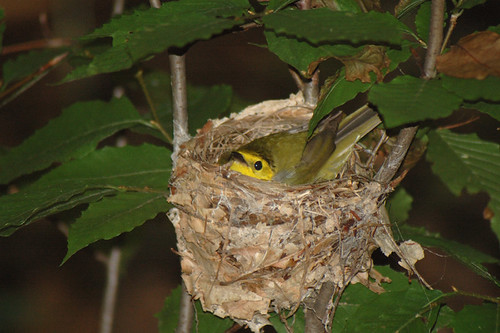
Nesting Female Hooded Warbler
I figure with the shortest day of the year around the corner, why not just post a reminder of summer time fun!
I would love to hear what helps you make it through the winter months?


 Mon@rch's Nature Blog