
Timberdoodle [Video]

American Woodcock photo by Grace – April 2007
One of the easiest ways of finding the American Woodcock (aka Timberdoodle) is to take a trip into a wet meadow around dusk and then wait. Not long after the sun sets you will witness one the most amazing flight display of any of our birds here in the North East. The male Timberdoodle will do its peent call for about 10 or 15 minutes and then take flight into the sky in a circular direction! The American Woodcock has developed a unique flight feather that allows the bird to create a whistle sound when heading towards the sky! After 2 or 3 circles, the bird will return to the earth with the most beautiful lullabies that you will ever hear! Once it has returned to the same location in which it started . . . the American Woodcock will return in peenting again and then repeat its flight display until it’s too dark to see! Below is the video that I captured on Easter Sunday of their display here in Allegany State Park!
(more…)
Pileated Woodpecker [video]

Pileated Woodpecker
Yesterday I came across this enormous black and white woodpecker with a conspicuous bright red crest, while it was working on excavating a huge hole. Actually, I found this bird not far from my mother’s house and was amazed that it allowed me to pull my vehicle right next to it . . . . and it wasn’t spooked!! This Pileated Woodpecker has very little red on its forehead and was lacking the red on the malar region making it a female. Looking at the first photo up close . . . you will notice her brown coloring contrasting with its black wing feathers, which can sometimes be difficult to reliably age the bird (believing that the faded brown feathers were her Juvenal feathers). But, seeing the gray/tan eye coloring (Adults have bright red eyes) will confirm that this woodpecker is a second year bird (meaning she was born during the summer of 2007).
(more…)
Yes . . . A Long-eared Owl

Long-eared Owl
This week Young Naturalist J was off from school (winter break) and once I learned the crew would be out trying to band Short-eared Owls . . . I just knew we had to go. Weather was a little iffy but the great banding team did a wonderful job getting everything set up! (more…)
Movement of Northern Saw-whet Owls

Northern Saw-whet Owl and the moon!
I am soo excited; I don’t know where to start. . . . ! Have you ever wondered where the bird you are looking at has been or where they are going? Previously I have discussed some interesting banding recoveries where I recorded two different Black-capped Chickadees who moved 3350 feet from their breeding territory to where they had been wintering (these were my own recaptured birds). I have also discussed on numerous occasions some exciting banding nights where I recaptured some foreign recaptured Northern Saw-whet Owls that had been previously banded by another bander. I am proud to announce that “today” I received a report that another bird bander recaptured one of my Northern Saw-whet Owl last fall (the first time this has ever happened to me, yah!!)!!
(more…)
Where Adult Butterflies Winter

Fallen into the snow!
When temperatures reach – 0°F you don’t expect to find any adult butterflies in your back yard. Ok, here is my story . . . Yesterday I planned on starting a fire in the fireplace to help defray the cost of my gas bill (because temperatures are soo cold). I brought my first load of wood into the house and then returned for my second load! I notice in the white snow something that looked exactly like a butterfly standing up! Naa, it had to be bark right? Nope, with a closer inspection it was an Eastern Comma that fallen out of the woodpile and into the snow! (more…)
The Banding [part 2]

Short-eared Owls amazing face pattern
Yesterday’s post was about the excitement of catching these two Short-eared Owls . . . Today I will be writing about the banding process, transmitter and releasing the owls (and a few cool photos). (more…)
Rufous vs Gray
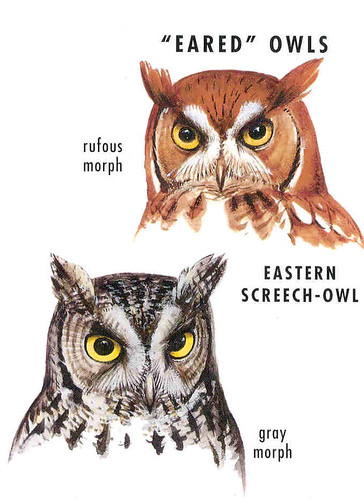
From the Peterson Field Guide.
The Eastern Screech Owl is a species that have two distinct morphs and live within the same population (polymorphism). It is generally known that gray-morphed Screech Owls are more frequently found in the North and the rufous-morphed birds are mostly found in the South. Many publications will discuss this relationship with the rufous-morphed birds not being able to handle the colder winters and I know there are some studies are trying to prove that. I did find an interesting publication by Mosher and Henny (1976) who explains how the rufous-morphed Screech Owls oxygen uptake is greater than the gray-morphed birds when exposed to lower temperatures. I have also heard about the relationship with the different morphs and tree species that are found in the areas !! (more…)
An Interesting Office Visitor
Have you ever been inside Wal-mart or Home Depot with birds flying around the store?? I feel sorry for those birdies and I find myself wondering who’s job it is to get them back outside safely?? Well, you know who gets the call whenever something is flying around the offices in the Administration Building!! I have rescued Chimney Swifts who accidentally fell down the chimney because someone forgot to close the damper. I am the one who saves the Little Brown Bats who accidentally finds there way inside whenever someone leaves a doors or window open due to hot temperatures during the summer. I have even rescued things like a Luna Moths (stuck between the storm windows), Hummingbirds, Meadow Jumping Mouse, Flying Squirrels, Ring-necked Snakes, and a ton of Chipmunks!! But I am rarely called upon during the winter months for unexpected critters that find there way into the offices (well, unless they are mice)!

Today’s Black-capped Chickadee.
Do you know your Bird Eggs? [QUIZ 2]
Looking at each egg will make you wonder what advantages or disadvantages it might have. Take for example cliff nesting birds who building their nest on large ledges. Maybe those eggs which are more pointed are less likely to roll off the ledge because they will instead roll in a tight arch?? Why are birds eggs colored differently?? Maybe from a predator’s vantage those green or blue eggs could look like a hole in the vegetation?? Those birds with white eggs might not need to be camouflage because both parents take turns incubating the eggs while protecting the white coloring from predators?? Maybe cavity nesting birds require that white coloring so that the parents don’t accidently break the egg while in the darkness of the cavity?? Are duck eggs oilier than normal eggs to help keep them more waterproof? So many questions that are being looked at by ornithologist today and their findings are helping us understand the unique features in the development of these eggs.

Checking out an Eastern Towhee Nest.
By posting these two birdQUIZs, I am hoping you will also look closer at each egg and try thinking why each egg looks the way that it does. This exercise will help you finding the proper owner of the broken or hatched egg shell that you find laying on the ground. Good Luck with the quiz!! (more…)
Do you know your Bird Eggs? [QUIZ 1]
Bird Eggs come in an array of shapes and sizes. They can be found elliptical, spherical or even oval in shape. Smaller eggs (like the Hummingbird) are the size of a pea and the larger eggs (like the Ostrich) can almost be the size of a football. Eggs are sometimes colored in ways of making them appear to be camouflage so that potential enemies are unable to locate them. An example would be the Killdeer who will lay her eggs on the rocky ground but assist in distracting the predator away with an injured wing display. Some species of birds have colors that will vary from egg to egg where others will always have the same reliable pattern. Many of our cavity nesting birds will have white or neutral colored eggs since they do not need their eggs camouflaged. Ducks eggs are larger in size in proportion of their adult sized body. Ducklings need to be ready to swim away as soon as they are born where most other nestlings are born feather-less and helpless. They do most of their developing within the first few weeks in the nest.

Hooded Warbler on her nest.
There are many different things to take in consideration when identifying the eggs of birds. Size, shape and coloring are the main ingredients in making the eggs identification but they are not always the most important details. Behavior and the birds natural history is sometimes very helpful way to identify a broken (or hatched open) egg that you might find on the ground. The birdQUIZ below is designed in helping you use everything I talked about in making the proper identification of these eggs!! Good Luck! (more…)
Understanding the bird’s toe arrangement
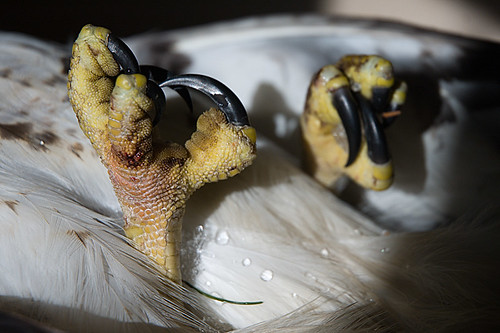
Red-tailed Hawk toes up close
Birds are recognized as being the “superb flyers” of the world. Although their wings are what helps them fly . . . . it is their feet and bill that help distinguish what ecological niche that hey live in. By studying their feet we can understand unusual behaviors and where they spend most hours of the day (tree, ground, water). We can look at the birds of prey who have armor protecting it from being bitten and sharp talons for grasping its prey. The grebe toes are lobed which will expand or contract as the bird swims or dives under water. Chickadees will uses its toes for grasp sunflower seed and then peck through the shell to get to the meat of the seed. Although there are many obvious features of the birds feet that helps it survive (as listed above) . . . I plan to discuss the 5 different toe arrangements that our birds have that help make those obvious features work! (more…)
My Irruption Northern Saw-whet Owl Year

First Northern Saw-whet Owl of the Season.
This year the Allegany State Park (Northern Saw-whet Owl) banding station was open for 28 nights and captured 83 different individuals with 90 total NSWO captures. We did not capture the hundreds of owls like the big migration sites but this stations numbers this season was significantly better than my previous three years of banding combined. The last two weeks in November resulted in very bad weather conditions (lake effect, strong winds and rain) which considerably reduced the number of net hours that the station typically operates. (more…)
People Trying to Help The Birds

Bonaparte’s Gull along Lake Erie
This weekend Young Naturalist J and I heard about some dead Common Loons that were found along Lake Erie (and had to check it out). We made a little detour from some roadside birding to check a public beach to see if the rumors were true. We found 4 dead loons in just one small area of the beach and it was soo sad seeing these guys. I found a press release that was released today discussing the die off of these Common Loons in this area and as we expected, they died due to Type E Botulism!
My backyard or is it their backyard?
Ever wonder about your neighbors that don’t speak any English? I have tried pishing (strange noise birders make to get the birds to come closer) those chickadees and I found that they only pish right back at me! Yesterday Young Naturalist J and I tried to learn about these seed hungry neighbors by doing some backyard banding. We were able to recapture 7 Black-capped Chickadees and 1 Slate-colored Junco.

Black-capped Chickadee. (more…)
Understanding the bird’s wing!

Osprey in flight (from March 2007)
Birds use the ability to fly for finding food, escaping from predators and even migrating to areas that can better support them when there are fewer resources available. Obviously their feathers are not permanent to their body and they need to replace their older (worn) feathers with new (sturdy) feathers. The molting (loosing and growing new feathers) patterns on the wing of the bird can help us banders understand the age of the bird (well sometimes). (more…)
Proper Identification
What is wonderful about watching birds is that you can enjoy them anywhere you go in the world and you can also enjoy them in multiple ways! I have some friends who are just backyard birders and they just want to be sociable with others. Then I have those friends who are “listers” and will travel multiple miles just to see one species of bird that accidentally shown up in their state. Most birders fit somewhere between those two extremes and of course I am not sure where I fit!! I spent multiple months studying them via the Ornithological side (which is more the job side of birding) but I do enjoy the sociable and recreational side of birding (which is the fun side of birding). It seems like the Ornithological side always gets in the way when I am just trying to enjoy the bird around me. This is exactly what happened to me today!

Eagle photo from my spotting scope!.
Weekend Visitors

Young Naturalist J glad to be banding again!!
We had more visitors at the Northern Saw-whet Owl banding station this evening than owls! I need to high-five Grace 🙂 for helping locate our 70th bird of the season (in the mist net) and then allowing me to barrow a book that I need to read. Mike and Terry decided to head home early after banding our first 2 fluff balls (thanks for visiting). Grace left only minutes before we captured our 3rd bird and then recaptured the 2nd bird again (The owl must be net happy). (more…)
Owls and other kinds of Owls!

Barred Owl
Another busy Owl night this evening!! Obviously looking at the photos . . . . I captured my first Barred Owl for the season!! Yes, I did get taloned on the finger by this bird but nothing too bad! 😦 (more…)
Less Daylight Hours and Spotted Salamanders

Spotted Salamander heading towards the woods.
I did a post almost 7 months ago on the migration of the Spotted Salamander. Each spring these large salamanders come out of the ground and migrate to special mud puddles called vernal pools. It is in these vernal pools where they breed and the females will lay their eggs. It is such an amazing spring time event and who would expect that I would find two of these salamanders crossing the roads during mid October (going the opposite direction?)? (more…)
Saw-whets . . . . did you expect anything else?

Foreign Recaptured Saw-whet!
Last night I caught another 3 more Northern Saw-whet Owls. These three were not your average captures and defiantly kept me on my feet while banding them. The first bird was a foreign recapture (banded by someone else) that was originally banded in Pennsylvania last November (2006). I can’t wait to hear more from the Bird Banding Lab about whom and where this bird was first found. (more…)
My Best Night Ever

The cutest fluff ball of the night!
I am soo tired and need to head to bed (it has been a long night!)! I just had to tell you about the 17 birds I caught this evening! Without a doubt this was my best night ever for the Allegany State Park Northern Saw-whet Owl banding station!! Perfect North East winds . . . . did I say perfect everything for migration?? I need to be at work at 8am tomorrow . . . . so I guess to continue going till sunrise isn’t an option!! When I closed my nets I could still hear a few Saw-whets moving around and vocalizing!! I should have stayed open!! Ugg (more…)
What an Owl Smells Like

Old picture of me teaching kids some bad habits
If you regularly follow this blog . . . . then you would know that I have an obsession with smelling the heads of woodpeckers. The woodpeckers head have a pine-musty odor to them but for some reason the smell is very pleasurable to me (ya, I am nuts – I know already)!! This evening while studying the migration of the Northern Saw-whet Owls . . . . I had a quick whiff of that odor! Bet you can’t guess what I did next?? (more…)
Glow Worms and Saw-whets in that order!

Glow Worm (Lighting Bug Larva)
Last night (9th October) was another successful evening with my Northern Saw-whet Owl Banding Project here in Allegany State Park. I opened the nets just after dusk and then headed out for my first net check at 8pm. I had hoped for some owls but was more dazzled by the number of lighting bug (or firefly) larva that I found moving along the ground. (more…)
Fluff Balls
Northern Saw-whet Owl
Yeah! I finally caught not just one but two fluff balls last night (8 October 2007)! I have had the Northern Saw-whet Owl banding station open here in Allegany State Park since the 30th of September and was starting to wonder “where are they”!! This isn’t my latest dates but it was very close to it! Back in 2004 when I first started banding Saw-whets . . . . I caught my first bird on the 9th of October and was my first night “ever” trying to catch any! Then in 2005 we caught our first one on the 3rd of October and last year (2006) we caught one on the 1st of October. It has been promising to know that other local (Western New Yorkers and North Western Pennsylvanian) Saw-wheters also have been behind in catching these guys. (more…)


 Mon@rch's Nature Blog