
North America Marsupial
Wednesday evening while returning from the Bill Thompson III talk, we came across an Opossum (Didelphis marsupialis) near where I had my truck parked in Allegany State Park, NY. Those red reflected eyes from the vehicle are unmistakable. After being skunked (not getting a good photo) of the skunk last month, I wanted to approach this little critter from a different angle. It started to run away as I approached and I did my very best to get between the goldenrod field and the Opossum. Everything happened so quickly but what I do remember is that it froze in place as if I couldn’t see it! No doubt that it played possum on me which is where it probably got its name. Opossum isn’t spelled how you expect it to be spelled, so I always call it the O’ possum.

Slowly – I moved closer and it allowed me to capture these pictures! You could tell that it was looking out the side of its eye, as if to wonder “what was the proper second for it to bolt away”! Moments later this gray mammal took advantage of me trying to get that close look and took off in a blink of an eye! I do remember looking at their funny feet and almost hairless tail. They can use this tail for assistance in climbing and on occasion hang upside down in a tree by their tail only.
As most know the Opossum is a members of the marsupial family (same family as the Kangaroo). They are unique mammal because the female carries their undeveloped young in an external abdominal pouch. I have seen an Opossum once around the feeder where the female was carrying around ~10 little ones. Those cute (yes I said cute) little ones quickly disappeared once I shined the flashlight on her (going into the pouch around the sides of her) and then she snarled at me. I quickly backed off realizing what I just witnessed.

You need to be very careful around the Opossum because they have very sharp teeth and will bite if they are threatened. What is unique is that they have more teeth than any other mammal in New York State (with 50 teeth total, 26 upper and 24 lower). They have a very large distribution across the east coast from the Great Lakes down to the tropics and South America. They typically live in hollow trees but on occasion are found under porches or even living in woodchuck holes.
The Opossum will leave little evidence that they in an area and are solely nocturnal. The males are more nomadic than the females and both just wonder around the woods/wetlands. They are omnivores and will eat nearly anything they can. Majority of their diet is smaller animals like insects, mice and even ground nesting birds (eggs, chicks).
I truly enjoyed getting this close encounter with this funny looking O’ possum last Wednesday. If you ever encounter this cat sized critter, please appreciate how unique it really is and get a good look of it. I promise it will be something that will remember for a long time.
Facts taken from: Jackson, Hartley H. T., 1961. Mammals of Wisconsin The University of Wisconsin Press. pp17 -25
Bill of the Birds talks about Roger Tory Peterson

On Wednesday Bill Thompson III spent the evening talking to many guest and members of the Roger Tory Peterson Institute (RTPI) in Jamestown, New York. B3 is the third author who has been invited to speak at the Distinguished Speaker Series at RTPI which was funded through the Johnson Foundation. He is best known as the editor and author of the magazine Bird Watchers Digest which was started by his father in the late 1970’s. He visited the institute to discuss his newest book called “All Things Reconsidered” which is a collection of essays written by the late Roger Tory Peterson.

During the “meet the author” reception; Bill told us some wonderful fun stories about himself as a kid becoming a birder. I will not get into too many details on how he had skipped school, ect… but I must admit that he had some wonderful roll models. I did love how his Grandmother insisted that when he was a little baby that his first words were “junco”!


During the lecture, Bill told us about how Roger Tory Peterson had been involved with the Bird Watchers Digest magazine since its very beginning. We learned about how his father confronted Roger in the mid 1980’s about doing an article for the magazine. Roger had thought about for a few minutes and ended up agreeing to do a column for the magazine (which continued up until his death in 1996). Bill went into wonderful discussion on how he was able to put this book together in honor of Roger Tory Petersons death 10 years ago. I strongly suggest you read this book to hear the whole story!!
I first had the opportunity to meet Bill Thompson III, from the American Online Birding chat room which I assisted in hosting from 1996 to 2001. Bill was one of the original people who assisted in getting this chat room established through AOL. Throughout the years, I had the opportunity to hear him and his wife speak at the Federation of New York State Birdclubs annual meeting (now called New York State Ornithological Association). My most memorable meeting of B3 and his family was at the Allegany Nature Pilgrimage here in Allegany State Park, New York – June of 2002.


I can’t remember if it was Bill or Julie (I think it was Julie because I remember the pet frog and bird story) but one of them was the main speaker under the big tent at Camp Allegany. What I do remember is Bill pulling out his guitar and the two started singing together. The most memorable part was that my 8 year old field assistant and I were invited to join their family out to France Brook road to do some birding. The kids (about the same age) had a great time identifying the numerous birds that we encountered and then found some cool insects together. This was a time period when I was really starting to learn my butterflies and Julie had pointed a few species out that I hadn’t learned yet. This will be a day that I will remember forever.
Even if you were unable to make it to the Roger Tory Peterson Institute to hear his talk, you can still learn from him at his Birding Blog at Bill of the Birds. His wife is also an remarkable blogger at Julie Zickefoose’s blog. I would like to thank Linda O. for first introducing me to their blog after the Scott Weidensaul’s talk. I knew that I had to add them to my RSS feeds ASAP and I know that you will equally enjoy their blog sites.
what is that in my bluebird box
Yesterday, I took a little hike down ASP Rt. 2 looking for some Shrikes or any other unique winter bird hiding in the shrubs. Being so quiet, I found myself looking inside some of my bluebird boxes that I have not checked since August (removing the older nest left by the bluebirds).

One of the boxes had been filled up with grass. Anyone who has worked with nest boxes knows that I am about to deal with some little furry mammal (not birds). Sure enough, there were 2 Deer Mouse holding their ground and not wanting to leave the box. I was just glad they didn’t run down my arm like they normally do when I open the box.

I questioned if I should have left these mice alone or just evict them. If this box was regularly used by Tree Swallow’s, I probably would have let them spend the winter there but this exact box has been one of my better Eastern Bluebirds boxes for the past 5 spring/summers. I am afraid that these mice might discourage any bluebird looking for a winter roost or for when the birds decided to start investigating for an empty box. I am also concerned that the urine left by the mice could attract predators which might destroy the box trying to get inside (This summer I had a Black Bear shred apart a box to get inside, ugg). Anytime you remove a mouse nest, you should always use protection over your face so that you don’t inhale any of their dandruff. You should also try leaving the box open for a week to dry the soaked mice urine left buy these cute furballs.
Last spring I encountered this Red Squirrel in one of the new boxes built by some Boy Scouts. It is hard to believe that something so big can live in such a little box. I have found that these squirrels do all kinds of damage by chewing the hole bigger which can then make it easier for predators (raccoons, ect..) to steal the baby nestlings or eggs from the box.
It can become a full time job taking care of all your bluebird boxes but very well worth seeing and hearing the birds out in the fields. I promise to keep you updated with this blog on how the boxes are doing here in Allegany State Park.
Morning Hike
The sun woke me up this morning and I had decided that I needed to take a nice hike. While filling the feeders, I found a cool bird wing imprint in the snow. Then I decided to head down to France Brook which always brings me some excitement. Had the most fun crunching the ice puddles along the road!


Birds were acting funny and the Bluejays kept on making these strange clicking sounds. To my surprise there was an adult Bald Eagle near the Beaver Ponds. It was a stunning bird and took off before I could get a good picture. Suddenly the Common Ravens circled and started chasing the Eagle. It was wonderful thing to watch! Besides this excitement with the eagle and Raven; there was your typical birds moving around in the shrubs which I enjoyed watching.


Tree Sparrow with more sticks in the way!! The one picture is of it itching.

Enjoyed finding a Song Sparrow in there!
After my hike, I visited my family and lost a bunch of money at the Casino!! Ugg, they opened a section in the new building and I had to check it out! It’s going to be a LONG time until I visit that place again!!
No power brings me to an early night’s sleep
Around noon yesterday there were numerous Severe Thunderstorm warnings issued by the National Weather Service! Once I got the report; I jumped right onto NEXRAD radar to see what was going on. There were numerous green, yellow and red images moving directly towards Allegany State Park. We started to prepare to notify everyone what was about to hit.
We witnessed rain like I have never seen before! With the ground over saturated, water started to puddle up everywhere!! A fellow worker called me over to her window to show me how the rain was moving sideways. I was just amazed at how the wind was pushing the puddles on the roads like waves on the beach. In just over an hour the rain had stopped with sunny and clear sky. I knew at this point this was truly a goofy day. The sun didn’t last long before the rain started up again but this time it didn’t come down as hard. Streams were rising quickly and we are all concerned that there could be some flooding.

About 3pm the lights started flickering and then you guess it, everything became dark. Things started to became hectic, phones ringing, people talking, ect..!! Didn’t take long before we realized that the power outage stretched further than just the park! Preliminary talk by police was that National Grid is expecting to get everything going again by 8pm (ya right). I needed to reschedule my haircut appointment and then decided to join my parents (who also didn’t have power) for a fish fry at my uncle’s restaurant (who did have power). I truly enjoyed seeing everyone and we had a wonderful meal. But we had no clue what to expect once we got home.

I saw my boss at the police office and decided to stop in to see what was going on. I learned that they had just got the emergency generator hooked up to the Administration Building and that there was a fire going in the fire place. The earliest the power will be turned back on is around 5am in the morning. I quickly went back home and spent a little time with the kitties. I figured that I would grab my laptop and return to the Administration Building to pass the time with power.

Back at the Administration Building there were a few families there who were also trying to get out of the darkness and stay warm. Last October they had experienced the week long power outage up in Buffalo. I pulled the TV out for the kids and we all watched the “Christmas Vacation” movie!! A few employees and myself had some wonderful conversations about what we had experienced throughout the day. I really enjoyed myself and glad that I decided to spend my evening with everyone (and with electricity). I was unable to connect to the internet (to update the blog) due to my phone service being out. So, I decided to head to bed early for once.
I noticed that my furnace started working again around 5:30 in the morning. I woke up with snow on the ground and found temps inside got as low as 48 degrees F. My phone service still isn’t working but now that the state of emergency and the driving ban has been lifted; I plan on going into town to find some phone service to upload this blog.
Update: I called windstream and they told me that someone will check my house by 5pm Monday evening (maybe sooner). I am not sure when I will be able to update the blog again (yes still have dial up).
The End of a Good Season
This year the Allegany State Park (Northern Saw-whet Owl) Banding Station was open for 28 nights and we captured 40 individuals with 49 total NSWO captures. We do not catch the large numbers like what the big migration sites catch but the numbers this season was significantly better than the previous two years. We caught an additional Barred Owl and Eastern Screech Owl during the project with the unexpected captures of some Northern Flying Squirrel, a Northern Long-eared Bat and then a White-tailed Deer which run through one of the nets.

A NSWO just after being released.
The percentage of captured males / female / unknown sex were fairly consistent with the previous year’s numbers. We also found similar consistency with hatch year and after hatch year birds. There was a significant increase of birds per 100 net hours and our capture numbers were also increased due to two big migration nights. On 26th October we had a 10 bird night with 3 additional birds returning to the mist net that same evening. The next big night was on the 10th of November with 9 new captures, 2 recaptures from the 26 th of October and one same night recapture. The birds who returned 15 days later both lost weight during their stopover.
|
|
Captured Individuals |
% Male |
% Female |
% Unknown Sex |
% Hatch Year |
% After Hatch Year |
Birds per 100 nethours |
|
2004 |
13 |
8 |
77 |
15 |
31 |
69 |
4.03 |
|
2005 |
26 |
12 |
69 |
19 |
58 |
38 |
2.87 |
|
2006 |
40 |
10 |
70 |
20 |
60 |
40 |
5.25 |
Part of being involved with Project Owlnet is the ability to network and share everyone’s knowledge with other Northern Saw-whet Owl Banders across North America. We are able to look for unique differences or similarities throughout each of the stations by using similar protocols. The obvious observations this year across the East Coast were that the Northern Saw-whet Owls were a week or two behind in their movement south. I have a strong suspicion that many of those birds had a longer stopover here in the Western New York area (as reported by my two 15 day recaptures). This season our last capture date was on the 24th of November which was 12 days after our 2005 late date. I have to agree with my fellow banders that these birds were behind in their movement south.

This picture is of a NSWO caught in the mist net.
On occasion we capture foreign owls originally banded by another bander. After reporting these finds to the Bird Banding Lab the Project Owlnet will sometimes assist in quickly connecting your wonderful find with the original bander. This season we were able to capture 3 foreign recaptured birds. We learned that 2 of the birds were originally banded in Ontario Canada and the 3rd owl had not been reported to the Banding Lab yet. I have a strong suspicion that this bird also came from Ontario Canada (time will tell).

A foreign recaptured NSWO (after second year) with a unique wing molt pattern
I would like to thank my banding assistant Jordon and numerous other volunteers which assisted me with the banding operations. It is with their help which keeps this station in operation and keep me entertained after my many long hours of sleepless nights. The season is being scheduled to start again October 1st, 2007 for Fall Migration here in Allegany State Park. I have to work out the detail but I would love to give Lake Erie State Park a try for Spring Migration. Please return to the blog to see any updates on my visits to the numerous Saw-whet Owl boxes which were placed by some Eagles Scouts last summer and any summer breeding pairs located!
Learning about Animal Sounds
This evening at the Roger Tory Peterson Ornithological Club, we had Greg Budney present a program on Animal Sounds. Greg is the Director of the Sound Collections from the Macaulay Library at the Cornell Lab of Ornithology. Don’t expect the Macaulay Library to be your typical library because they have very few books on their shelves! They have the largest archive of animal sounds and associated video located anywhere in the world. You can find the natural behavior/vocalizations from the large whale to your local tiny leaf hopper. They have a very long hisotry of inventorying from way back when the lab first originated.
I had an opportunity to visit the library back in 1997 when working on some studies with post nesting vocalizations of the Veery. The staff was extremely helpful with our numerous goofball questions and they gave us a wonderful tour of their facilities (3 years ago they moved into a new building). After leaving the Library, we felt more confident in capturing the needed data for the project but funding never became available and we only collected some preliminary data for the project!

Greg Budney’s program this evening didn’t consist of any slides or pictures but we solely used our ears for this program. He played some sounds from animal that are commonly heard in movies to very low frequencies of the alligator which show vibrations of water before hearing the sound. We learned how researchers use these sounds for endangered species and discovered how insects use vibrations for communications. Best part of the program was learning what a researcher accidentally hitting another research’s head with a paddle (waking them up) sounds like over the microphone. Greg was a wonderful speaker and he helped remind me how important it is to use our ears while out in the field. While leaving the Roger Tory Peterson Institute we heard a Spring Peepers vocalizing behind the building (Linda and a few others at the meeting talked about hearing these guys squeaking, glad to have heard them also).
Do visit the Macaulay Library free online Animal Behavior Archive website.
Are Muskrats being territorial or just having fun
Yesterday, I truly enjoyed my walk around Red House Lake in the warm sunny weather. I saw numerous birds including Dark-eyed Juncos, Tufted Titmouse, American Tree Sparrows, and even some Horned Grebes. In the area that I call “duck pond” there were 11 or so Mallards feeding in the weeds.
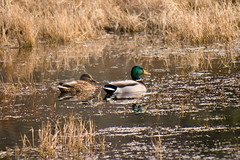
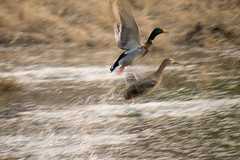
Something didn’t appear to be right with these Mallards due to a majority of the ducks were ignoring me and swimming around in an almost circle direction. A few did take flight but there were others that just held their ground. I knew this couldn’t be a game of duck-duck-goose; so the binoculars came out for a closer inspection. To my surprise there was a Muskrat chasing the Mallards around the pond! I have always understood that Muskrats are commonly found in areas the dabbling ducks like to feed and that they are mainly herbivores (but on occasion will feed on crayfish, ect). Could this muskrat be looking for a quick meal?? I doubt it!! But, I never expected to see such persistency in this mammal moving these ducks away from this particular area. It almost became comical to watch.
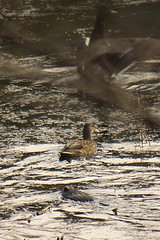
The Muskrat (Ondatra zibethicus) gets its name from a musky aroma which follows them around into their grass lined dens. I questioned if this Muskrat was having fun or just being very protective of its territory. Numerous of the field guides that I have been flipping through do note that they are very territorial and one did note that they “have been observed chasing away dabbling ducks”. Doesn’t matter what the books say, this Muskrat appeared to be having fun to me!! I think that over the winter months that I need to keep an eye on this musky furry friend. (Did the best I could photographing the Muskrat through the trees)
fun two owl species night!
We caught and banded two different species of owls last night. Since this project is about studying the migration of the Northern Saw-whet Owls, we obviously did catch one of these fuzz balls. If you would have told me a month ago that I would still be catching so many of these owls this late in the season, I would have just shook my head and smiled. Once again, there is still a great deal that needs to be learned about these owls! About 10-15 years ago we didn’t even know that Saw-whet Owls migrated, yet alone realize how common they really are.
Didn’t I mention that I caught two different species of owls?? Sometimes you “JUST” have a feeling that there are birds around. I had this “feeling” on my midnight check last night. I walked to the end of the nets – with no owls. Turned around and started walking back with a larger bird which I spooked and it flew right into the nets. With my mind started thinking quickly, “no way is that a saw-whet”, then “could it be a Long-eared Owl”??. Ok, I did hear one in 2004 vocalizing around the nets but someday my dream might come true that we’ll catch one! This time it was the turn of the Eastern Screech Owl (gray phase). Although they are commonly heard around the house, I have never heard one vocalizing way up the hill where the nets are located. This was an absolute surprise and a first for the project. I do hope in the future that these birds decided to use my nest boxes that I have placed back behind the house. It has been 3 years now and I probably should choose a better location which would be less interesting to the starlings.

Screech Owls do come in two color phases. The gray phase is the most common color phases but on occasion, we do encounter the red phase. About two weeks ago; one of the maintenance guys (for the museum) brought me a dead red phase which was located along the road here in Red House. They said they had a small brown owl and my first thought was “Saw-whet”! But this bird did turn out being my first red phased Eastern Screech Owl that I have encountered here in the park in a very long time. It was a sad find but also an interesting find.

Winds are picking up this evening and I plan on staying open as long as possible without having to close. I do anticipate this might be my last evening unless the weather man is wrong with his predictions for the rest of the week. Winds are picking up, bad weather is approaching quickly and the moon will be getting brighter and higher in the sky every night. It has been a wonderful season and it is very sad that this will be coming to the end soon. When I do finally call it quits, I will give an overall summery for everyone to read. Wish me luck tonight!
Sun, Stars and the Night Sounds
I find myself turning off my headlamp after checking the nets for owls!! There is nothing like walking through the woods in the absolute darkness. It’s only you and the sparkling stars which are leading you back to the banding station. Yes, I slip in the mud, crunch in the frozen leaves and even trip over twigs, but there is no way I would have wanted to miss that green shooting star streaking across the sky. Looking up, I see my favorite star cluster which takes me back to the main part of the road. Hmmm ….. Oooo ….. wait…… what is that cluster called??? Ugg, I can never remember those star names!!

When you find yourself in total darkness, your other senses take control. What are those squeaking sounds?? Isn’t this where I always see that Peromyscus mouse looking for food in the mud?? What’s that smell?? Are those Geese down on the lake?? No wait, that’s a pack of coyotes vocalizing?? Quickly, headlamp comes on; flash light come out from the pocket; I start walking quicker.
This is the coldest it has been since early November when we were hit with the lake effect snow. Even with the sun out today, the temperatures never got above 37 degrees F. I seriously considered taking the day off of work to get out enjoying the sun. But, I continued the numerous projects that I was working on and dreamed about the possibilities of catching a fluff ball tonight.
The past two nights had perfect North West winds which resulted in no birds. Now tonight we had light South West winds and resulted in catching three Northern Saw-whet Owls. One of which was a foreign recaptured bird (originally banded by someone else) from Ontario Canada in 2005. Isn’t it amazing that I can report a band number to the Bird Banding Lab and within seconds have its life history? Then again, isn’t it amazing your all reading my blog and finding out what I have been up to??
BTW: I remember now, Cassiopeia is the star cluster which I love! Why can’t I remember this Queens name?? You think I would remember!!
Scott Weidensaul Returns to Wild America

On Wednesday author/ornithologist Scott Weidensaul spent the day speaking to many guest and members of the Roger Tory Peterson Institute in Jamestown, New York. I have had numerous communications with Scott via email due to my Saw-whet Owl studies here in Allegany State Park. I found it a pleasure in finally meeting him in person. I recommend that you take the time to read his book “Living on the Wind” which has won the 1999 Pulitzer Prize. I love this book so much that I have quoted the “studying bird migration by the full moon” info in my Mon@rch Nature Blog.
Scott currently has numerous bird banders and volunteers involved with his Northern Saw-whet Owl banding project. Currently he oversees 3 banding stations located across southern Pennsylvania and has had a very low number of captures this season. We were comparing our numbers of owls, mice heard and of course this wet weather. I hope Scott is correct with his prediction that next season will be an irruption year for these little fuzz balls. During the “meet the author” reception, Scott discussed what genetic studies his team has been looking at across North America, some radio telemetry work being done in Pennsylvania and discussion on how he is using this information to better understanding the nomadic behaviors of these owls.
Scott continued in his discussion on some of his other studies involving western hummingbirds that have showed up across the eastern North America. He described some of the theories on why this has started to occur and what it means for those rare species that are regularly visiting people’s hummingbird feeders.
Further discussions reveled that Scott is also very interested in herpetology since childhood. I feel very fortunate to learn about an experience he had with a Milk Snake and the proper ways of grasping these snakes.

The main lecture was focused on his new book “Return to Wild America”. In 1953, Roger Tory Peterson and British Ornithologist James Fisher adventured down the east coast starting in Newfoundland, across the Florida Keys into Mexico, then up into Alaska. Scott followed this North American tour exactly 50 years after these two renowned naturalists took the trip and Scott was successful in describing the changes (good and bad) which have occurred over those 50 years. He showed a beautiful slide program with descriptions on how the two adventures were similar and different. I will let you read the book to hear some of those stories but you had to be there to experience the sound effects he vocalized and his discription of visualizing some sausages he saw out on the beach. I enjoyed this slide program and suggest that you take the time to visit him when he speaks at a Nature Center near you.
Overall, Scott was a very kind hearted individual and I would have loved to spend some time out in the field with him. He autographed my book with “For Tom, a fellow Saw-whet Nut – keep sending them south!”. You can purchase his book at Amazon.com to read more about his adventure.


Next author being scheduled at the Roger Tory Peterson Institute is Bill Thompson III (still unsure the date and time). Bill is the current owner of Birdwatchers Digest and both Bill and his wife (Julie) are wonderful “entertaining” speakers. I recently learned about their blogs at Bill of the Birds and Julie Zickefoose blog and plan on visiting these blogs on a daily basis. I am lucky to say that I have had the opportunity to meet both of them on numerous occasions. The family has gone camping here in Allegany State Park during the Allegany Nature Pilgrimage and I have run into him at a few conferences that I have attended. I expect this to be equally entertaining program and I hope you are able to attend.
Late Monarch Movement

Originally uploaded by Mon@rch.
Today I observed a Monarch here in Allegany State Park during its migration to Mexico. Today’s weather was in the upper 50’s with calm wind and clear skies. Who would have expected to see any more Monarch’s this season after the numerous snowstorms, down pour rain, windstorms and hard frosts that have occurred. This will probably be my last Monarch of the season that I will encounter!
FYI: This photo wasn’t the monarch that I observed, it was taken in August.
Largest Bird in the World Discovered
Mon@rch News:
While listening to NPR radio yesterday, I learned that an Argentina teenager discovered a near complete skull and leg bone of the largest bird in the world. This skull places this newly found species in the phorusrhacid family which scientists are calling the “terror bird”.
It was published in the Journal “Nature” (volume 443, page 929) that this flightless bird was about 3 meters tall with its head about the size of horse. This species had the speed of a grayhound dog. The Terror Bird survived about 60 millions years after the death of the dinosaurs. It was one of the largest predators dominating the grasslands of South of America and survied up to about 2 millions years ago. For more info be sure to check out the following links:
Giant Terror Bird was light on its feet – New Scientist

Grouse Displaying
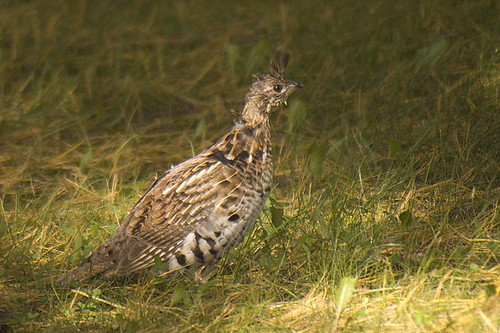
I have never seen so many grouse as I have just before the start of Grouse season. While getting out of my truck for a closer photo, this grouse started to display.


Suddenly the male Ruffed Grouse took off and stopped my heart from whizzing past my head. Now all relaxed, I started to walk towards the tree (saw a feather on the ground and wanted a closer look) and then my heart stopped again! There was a female behind the tree which I didn’t realize was there. What a wonderful life I have.
Basement Vistor
One of the Park Naturalist brought this little critter to my office and notified me that he had just caught it in the basement. For a short time we were identifying this as something else until PG (who was babysitting it) said “its brownie” pointing to its picture in the field guide! After going through all the keys and reading up on it – she was correct that this little mouse was a Meadow Jumping Mouse Zapus hudsonius.

Some interesting details that we learned about brownie was that it should have much longer hind legs than its front legs, its tail is twice as long as the body and fur has an interesting yellowish brown (almost red highlights) to it. This mouse does resemble the Woodland Jumping Mouse but doesn’t have the white tipped tail like the woodland species has. Some other interesting facts that we learned is that its first jump is about 2-3 feet and then follow with smaller hops (which made it hard for the Naturalist to capture – I would have loved to watch the capture). I really found interesting is that this species will go into hibernation from late October to Mid May (for over a ½ year). Just remember that these mice are food to the many other animals that we love to photograph! It’s a mammal that we rarely see being that they are most active at night and sleeping most of the year. After observing this little mouse in the office we released it over on the other side of the lake with hopes to making many more baby mice.

The Day of Exploring New Territory

Common Garter Snake (Thamnophis sirtalis)
This was a wonderful day today! Weather was perfect and I was given many photograph opportunities. I was invited to join two inspirational biologists in search of some fall wildflowers in an area of the park that I have never explored before. Here I would like to include a few other photos from our hike trip up into the woods.


These two flowers (Zigzag Goldenrod and Crooked-stem Aster) were located along the forest edge. They both have that Zig n Zag feel to them and its ironic that they were growing together. The Zigzag Goldenrod was a wildflower that I never took the time to identify until this trip.

This Magnolia Warbler was showing off its yellow coloring which let me get a quick photo or two before disappearing into the shrubs. There were a few Magnolia’s flying around but most of them were high up into the canopy. Some Common Yellowthroats, Chickadees and a Thrush species was in the same area with the Magnolia.

While leaving, we came across this Green Heron in the wet grass while searching for some shorebirds. Was wonderful it would pop its tuft up and get a grasshopper or two. We were lucky to have watched it for about 4 minutes before disappearing into the grass.
Nodding Ladies’ Tresses Orchid (Spiranthes cernua)

While checking out the other wildflowers – we happened to come across these Nodding Ladies’ Tresses Orchid Spiranthes cernua!! They are such interesting looking Orchids with the flowers spinning around in spirals. The pictures tell it all!


Young Woodturtle Found
Found a very tiny Wood Turtle Clemmys insculpta along the Horse Trail here in Allegany State Park. No one in the group had seen this species this small before. Its measurements was 110mm by 80mm which is very tiny (check this photo Adult Woodturtle to see the typical size that I see them). Also, this turtle had an older cracked shell incident which we are guessing was caused by a horse stepping on it (shape and size). It is probably a few years of age and appeared to have survived the accident with the cracked shell (starting to grow together). But, this turtle did have paralyzed hind legs and would drag it with its front legs!


Closed Gentian
Here is Closed Gentian which the purple or blue flower is commonly found here in AlleganyState Park in the woods or wet meadows.


This flower is unique that there is a white form of this plant. An interesting fact which we learned about Closed Gentian is that the only insect which can successfully pollinate this flower is the bumblebee (Flora of Michigan). We are double checking to make sure this isn’t a different species but its leaning towards being the white form of Closed Gentian.

Deer More Interested in Apples than Me
These White Trailed Deer let me walk right up to them and take their picture! I do get to see the deer feeding on these apples quite often but these really did not care that I was there.


Movement of some Northern Ring-necked Snakes
Was an interesting day today! Heading back to work from my lunch break – I located a Northern Ring-necked Snake in the middle of the road. Took a few pictures and then let it go! What was so interesting was that another one of these young Ring-necked Snakes were found inside the administration building. It obviously was a different individual by the amount of orange ring around its neck and the first one looked like it was going to shed soon. Just can’t figure out where these snakes are coming from??


I did let both of them go in the direction towards the picnic area.
Dogwood Berries is good source of food!
I have been seeing many birds recently feeding on the Dogwood Berries along the bike path here in Red House!! Here are some of the birds that I observed:
Red Eyed Vireo


Yellow-rumped Warbler (note its banded and probably one of my birds)


Lots of fruit in the forest for both birds and other wildlife! Do keep your eyes open!!
Is that a….. your kidding me…..
I can now say to expect the unexpected here in Allegany State Park. Today we had an unexpected visitor here at the Administration Building which got trapped in one of our window wells (probably at night sometime). Don’t ask how a mammal that lives in the water ends up in a location like this (up a hill, behind a building and quite a distance from water) but this is proof that it can happen. Typically we get a toad (wait, there already is a toad in there), salamanders or even a snake stuck in these wells. Mammals typically are able to climb out or they might decide to climb in and eat these other critters. This window well was just a little too tall for this beaver to climb out. Luckly P.G. happened to be out for a cigarette break and heard a noise!

Trapping wasn’t easy be we were able to get this beaver into the trash can. The officer that assisted ended up with some beaver scat on his leg (whoops). We were quickly off to the lake to be released. Of course, it didn’t take long for a crowd to show up excited to see the release. Once we opened the can the beaver slowly walked out and headed right to the creek which empties into Red House Lake this location.

Once in the water the beaver got very low and tried getting as much of its fur wet as possible (creek water was shallow). It then headed down the stream dtowards the lake (moved must slower than I had expected).

When the beaver made it over to deeper water – it took a small dive and then ended up in the middle of the lake in about 10 seconds! I would like to wish our beaver friend good luck and a fun adventure very away from buildings!
Bear Visit
Today the weather temp was a high of 86.2F and Low of 54.6F. About 8:30pm there was something that just told me to get up and look outside. What I found was a HUGE black bear that is probably around 200 pounds. It was checking out my grill which I had cooked hamburgers earlier. It then started climbing the tree and eating some sunflowers from my squirrel proof feeder (notice I said squirrel proof). Typically I take this down each evening but this guy beat me to it!! Ugg, Anyways, I started scrambling getting my camera in order to try and take some pictures! Of course, my screen door just kept on making the pictures look goofy but I did luckily get a shot in.

Not long after taking the picture, the bear got startled and climbed down the tree. It circled the tree and the bear started coming towards my screen door. I was probably about 5-7 feet away when I slammed the heavy thick door which in turn got the neighbors dog barking. This startled the bear and up into the woods it ran.

I believe that this bear started coming towards the house thinking I was going to give it handouts! The problem is that too many people try feeding the bears. Although I was very close to the bear, I was safe for the fact that I was able to close the door where it couldn’t get me. People don’t always have that opportunity and chance that the bear could turn on them. Just seeing a huge mammal like this had my heart pumping and was an amazing rush! There is just nothing like that experience!! So, if you do come across a bear in the wild, please don’t try to feed it! Making noise typically is enough to scare it away.


 Mon@rch's Nature Blog