
Evening Birdwatching
Tonight a few of us from the Cattaraugus County Bird Club went in search of the Short-eared Owl! It has been a few years since anyone has recorded them within the county and I would like to add them to my county list. In years past we have traveled to see these birds in the neighboring counties. I still remember that one owl in Genesee County that landed on a telephone pole right next to our vehicle. It would hunt the field right next to us and then return back to that same pole. If only I had my camera on me!! Then there were those 5 or 6 Short-eared Owls in Niagara County that decided to roost in someone’s Christmas decorated shrubs right next to their house. They looked like very large ornaments but these ornaments would disappear one by one once it got dark. I now wonder what we might encounter here in Cattaraugus County?

We started the adventure in an area heavily population by the Amish because they have what we think is the Short-eared Owl’s preferred hunting habitat (hay stacks, large open fields and fence post). Early evening we located our first of the seasons Northern Shrike and light phased Rough-legged Hawk (sorry about the picture below, it was quite a distance away). I hope that in the next few months that I will see more of them and get some better pictures to post.
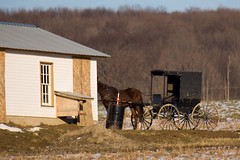

About 20 minutes before dusk, Tim saw an accipiter in the tree which we needed to investigated closer. It was spooked and as soon as it took flight we were confident that it was an immature Coopers Hawk. But, what we didn’t expect was that it would be chased by another bird of prey. Tim was outside the vehicle with a better view and asked if we had seen the Merlin!! Mike and I quickly jumped out of the vehicle and said, “Merlin”?? Tim pointed to the tree that it was sitting in (photo below) and became very excited. After we all got some wonderful looks we tried to get closer and of course it took flight again. We tried to follow it but the Merlin disappeared while chasing some starlings. I strongly cropped this picture to make it full framed but the picture of it in flight shows its field marks better. This is a species who’s population in this area have been increasing over the past few years and could be our first winter record for this bird. No doubt that it was the best bird of the night.


Obviously we didn’t find any Short-eared Owls but we did had a fun trying. I will be attending a workshop organized by The Nature Conservancy for the next few days. I am not sure when I will be able to update the blog again but I promise to put some good stuff on here soon.
Bill of the Birds talks about Roger Tory Peterson

On Wednesday Bill Thompson III spent the evening talking to many guest and members of the Roger Tory Peterson Institute (RTPI) in Jamestown, New York. B3 is the third author who has been invited to speak at the Distinguished Speaker Series at RTPI which was funded through the Johnson Foundation. He is best known as the editor and author of the magazine Bird Watchers Digest which was started by his father in the late 1970’s. He visited the institute to discuss his newest book called “All Things Reconsidered” which is a collection of essays written by the late Roger Tory Peterson.

During the “meet the author” reception; Bill told us some wonderful fun stories about himself as a kid becoming a birder. I will not get into too many details on how he had skipped school, ect… but I must admit that he had some wonderful roll models. I did love how his Grandmother insisted that when he was a little baby that his first words were “junco”!


During the lecture, Bill told us about how Roger Tory Peterson had been involved with the Bird Watchers Digest magazine since its very beginning. We learned about how his father confronted Roger in the mid 1980’s about doing an article for the magazine. Roger had thought about for a few minutes and ended up agreeing to do a column for the magazine (which continued up until his death in 1996). Bill went into wonderful discussion on how he was able to put this book together in honor of Roger Tory Petersons death 10 years ago. I strongly suggest you read this book to hear the whole story!!
I first had the opportunity to meet Bill Thompson III, from the American Online Birding chat room which I assisted in hosting from 1996 to 2001. Bill was one of the original people who assisted in getting this chat room established through AOL. Throughout the years, I had the opportunity to hear him and his wife speak at the Federation of New York State Birdclubs annual meeting (now called New York State Ornithological Association). My most memorable meeting of B3 and his family was at the Allegany Nature Pilgrimage here in Allegany State Park, New York – June of 2002.


I can’t remember if it was Bill or Julie (I think it was Julie because I remember the pet frog and bird story) but one of them was the main speaker under the big tent at Camp Allegany. What I do remember is Bill pulling out his guitar and the two started singing together. The most memorable part was that my 8 year old field assistant and I were invited to join their family out to France Brook road to do some birding. The kids (about the same age) had a great time identifying the numerous birds that we encountered and then found some cool insects together. This was a time period when I was really starting to learn my butterflies and Julie had pointed a few species out that I hadn’t learned yet. This will be a day that I will remember forever.
Even if you were unable to make it to the Roger Tory Peterson Institute to hear his talk, you can still learn from him at his Birding Blog at Bill of the Birds. His wife is also an remarkable blogger at Julie Zickefoose’s blog. I would like to thank Linda O. for first introducing me to their blog after the Scott Weidensaul’s talk. I knew that I had to add them to my RSS feeds ASAP and I know that you will equally enjoy their blog sites.
what is that in my bluebird box
Yesterday, I took a little hike down ASP Rt. 2 looking for some Shrikes or any other unique winter bird hiding in the shrubs. Being so quiet, I found myself looking inside some of my bluebird boxes that I have not checked since August (removing the older nest left by the bluebirds).

One of the boxes had been filled up with grass. Anyone who has worked with nest boxes knows that I am about to deal with some little furry mammal (not birds). Sure enough, there were 2 Deer Mouse holding their ground and not wanting to leave the box. I was just glad they didn’t run down my arm like they normally do when I open the box.

I questioned if I should have left these mice alone or just evict them. If this box was regularly used by Tree Swallow’s, I probably would have let them spend the winter there but this exact box has been one of my better Eastern Bluebirds boxes for the past 5 spring/summers. I am afraid that these mice might discourage any bluebird looking for a winter roost or for when the birds decided to start investigating for an empty box. I am also concerned that the urine left by the mice could attract predators which might destroy the box trying to get inside (This summer I had a Black Bear shred apart a box to get inside, ugg). Anytime you remove a mouse nest, you should always use protection over your face so that you don’t inhale any of their dandruff. You should also try leaving the box open for a week to dry the soaked mice urine left buy these cute furballs.
Last spring I encountered this Red Squirrel in one of the new boxes built by some Boy Scouts. It is hard to believe that something so big can live in such a little box. I have found that these squirrels do all kinds of damage by chewing the hole bigger which can then make it easier for predators (raccoons, ect..) to steal the baby nestlings or eggs from the box.
It can become a full time job taking care of all your bluebird boxes but very well worth seeing and hearing the birds out in the fields. I promise to keep you updated with this blog on how the boxes are doing here in Allegany State Park.
Morning Hike
The sun woke me up this morning and I had decided that I needed to take a nice hike. While filling the feeders, I found a cool bird wing imprint in the snow. Then I decided to head down to France Brook which always brings me some excitement. Had the most fun crunching the ice puddles along the road!


Birds were acting funny and the Bluejays kept on making these strange clicking sounds. To my surprise there was an adult Bald Eagle near the Beaver Ponds. It was a stunning bird and took off before I could get a good picture. Suddenly the Common Ravens circled and started chasing the Eagle. It was wonderful thing to watch! Besides this excitement with the eagle and Raven; there was your typical birds moving around in the shrubs which I enjoyed watching.


Tree Sparrow with more sticks in the way!! The one picture is of it itching.

Enjoyed finding a Song Sparrow in there!
After my hike, I visited my family and lost a bunch of money at the Casino!! Ugg, they opened a section in the new building and I had to check it out! It’s going to be a LONG time until I visit that place again!!
The End of a Good Season
This year the Allegany State Park (Northern Saw-whet Owl) Banding Station was open for 28 nights and we captured 40 individuals with 49 total NSWO captures. We do not catch the large numbers like what the big migration sites catch but the numbers this season was significantly better than the previous two years. We caught an additional Barred Owl and Eastern Screech Owl during the project with the unexpected captures of some Northern Flying Squirrel, a Northern Long-eared Bat and then a White-tailed Deer which run through one of the nets.

A NSWO just after being released.
The percentage of captured males / female / unknown sex were fairly consistent with the previous year’s numbers. We also found similar consistency with hatch year and after hatch year birds. There was a significant increase of birds per 100 net hours and our capture numbers were also increased due to two big migration nights. On 26th October we had a 10 bird night with 3 additional birds returning to the mist net that same evening. The next big night was on the 10th of November with 9 new captures, 2 recaptures from the 26 th of October and one same night recapture. The birds who returned 15 days later both lost weight during their stopover.
|
|
Captured Individuals |
% Male |
% Female |
% Unknown Sex |
% Hatch Year |
% After Hatch Year |
Birds per 100 nethours |
|
2004 |
13 |
8 |
77 |
15 |
31 |
69 |
4.03 |
|
2005 |
26 |
12 |
69 |
19 |
58 |
38 |
2.87 |
|
2006 |
40 |
10 |
70 |
20 |
60 |
40 |
5.25 |
Part of being involved with Project Owlnet is the ability to network and share everyone’s knowledge with other Northern Saw-whet Owl Banders across North America. We are able to look for unique differences or similarities throughout each of the stations by using similar protocols. The obvious observations this year across the East Coast were that the Northern Saw-whet Owls were a week or two behind in their movement south. I have a strong suspicion that many of those birds had a longer stopover here in the Western New York area (as reported by my two 15 day recaptures). This season our last capture date was on the 24th of November which was 12 days after our 2005 late date. I have to agree with my fellow banders that these birds were behind in their movement south.

This picture is of a NSWO caught in the mist net.
On occasion we capture foreign owls originally banded by another bander. After reporting these finds to the Bird Banding Lab the Project Owlnet will sometimes assist in quickly connecting your wonderful find with the original bander. This season we were able to capture 3 foreign recaptured birds. We learned that 2 of the birds were originally banded in Ontario Canada and the 3rd owl had not been reported to the Banding Lab yet. I have a strong suspicion that this bird also came from Ontario Canada (time will tell).

A foreign recaptured NSWO (after second year) with a unique wing molt pattern
I would like to thank my banding assistant Jordon and numerous other volunteers which assisted me with the banding operations. It is with their help which keeps this station in operation and keep me entertained after my many long hours of sleepless nights. The season is being scheduled to start again October 1st, 2007 for Fall Migration here in Allegany State Park. I have to work out the detail but I would love to give Lake Erie State Park a try for Spring Migration. Please return to the blog to see any updates on my visits to the numerous Saw-whet Owl boxes which were placed by some Eagles Scouts last summer and any summer breeding pairs located!
Learning about Animal Sounds
This evening at the Roger Tory Peterson Ornithological Club, we had Greg Budney present a program on Animal Sounds. Greg is the Director of the Sound Collections from the Macaulay Library at the Cornell Lab of Ornithology. Don’t expect the Macaulay Library to be your typical library because they have very few books on their shelves! They have the largest archive of animal sounds and associated video located anywhere in the world. You can find the natural behavior/vocalizations from the large whale to your local tiny leaf hopper. They have a very long hisotry of inventorying from way back when the lab first originated.
I had an opportunity to visit the library back in 1997 when working on some studies with post nesting vocalizations of the Veery. The staff was extremely helpful with our numerous goofball questions and they gave us a wonderful tour of their facilities (3 years ago they moved into a new building). After leaving the Library, we felt more confident in capturing the needed data for the project but funding never became available and we only collected some preliminary data for the project!

Greg Budney’s program this evening didn’t consist of any slides or pictures but we solely used our ears for this program. He played some sounds from animal that are commonly heard in movies to very low frequencies of the alligator which show vibrations of water before hearing the sound. We learned how researchers use these sounds for endangered species and discovered how insects use vibrations for communications. Best part of the program was learning what a researcher accidentally hitting another research’s head with a paddle (waking them up) sounds like over the microphone. Greg was a wonderful speaker and he helped remind me how important it is to use our ears while out in the field. While leaving the Roger Tory Peterson Institute we heard a Spring Peepers vocalizing behind the building (Linda and a few others at the meeting talked about hearing these guys squeaking, glad to have heard them also).
Do visit the Macaulay Library free online Animal Behavior Archive website.
Are Muskrats being territorial or just having fun
Yesterday, I truly enjoyed my walk around Red House Lake in the warm sunny weather. I saw numerous birds including Dark-eyed Juncos, Tufted Titmouse, American Tree Sparrows, and even some Horned Grebes. In the area that I call “duck pond” there were 11 or so Mallards feeding in the weeds.
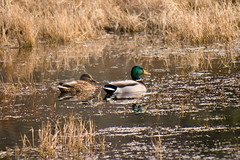
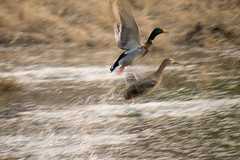
Something didn’t appear to be right with these Mallards due to a majority of the ducks were ignoring me and swimming around in an almost circle direction. A few did take flight but there were others that just held their ground. I knew this couldn’t be a game of duck-duck-goose; so the binoculars came out for a closer inspection. To my surprise there was a Muskrat chasing the Mallards around the pond! I have always understood that Muskrats are commonly found in areas the dabbling ducks like to feed and that they are mainly herbivores (but on occasion will feed on crayfish, ect). Could this muskrat be looking for a quick meal?? I doubt it!! But, I never expected to see such persistency in this mammal moving these ducks away from this particular area. It almost became comical to watch.
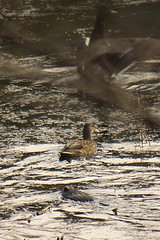
The Muskrat (Ondatra zibethicus) gets its name from a musky aroma which follows them around into their grass lined dens. I questioned if this Muskrat was having fun or just being very protective of its territory. Numerous of the field guides that I have been flipping through do note that they are very territorial and one did note that they “have been observed chasing away dabbling ducks”. Doesn’t matter what the books say, this Muskrat appeared to be having fun to me!! I think that over the winter months that I need to keep an eye on this musky furry friend. (Did the best I could photographing the Muskrat through the trees)
fun two owl species night!
We caught and banded two different species of owls last night. Since this project is about studying the migration of the Northern Saw-whet Owls, we obviously did catch one of these fuzz balls. If you would have told me a month ago that I would still be catching so many of these owls this late in the season, I would have just shook my head and smiled. Once again, there is still a great deal that needs to be learned about these owls! About 10-15 years ago we didn’t even know that Saw-whet Owls migrated, yet alone realize how common they really are.
Didn’t I mention that I caught two different species of owls?? Sometimes you “JUST” have a feeling that there are birds around. I had this “feeling” on my midnight check last night. I walked to the end of the nets – with no owls. Turned around and started walking back with a larger bird which I spooked and it flew right into the nets. With my mind started thinking quickly, “no way is that a saw-whet”, then “could it be a Long-eared Owl”??. Ok, I did hear one in 2004 vocalizing around the nets but someday my dream might come true that we’ll catch one! This time it was the turn of the Eastern Screech Owl (gray phase). Although they are commonly heard around the house, I have never heard one vocalizing way up the hill where the nets are located. This was an absolute surprise and a first for the project. I do hope in the future that these birds decided to use my nest boxes that I have placed back behind the house. It has been 3 years now and I probably should choose a better location which would be less interesting to the starlings.

Screech Owls do come in two color phases. The gray phase is the most common color phases but on occasion, we do encounter the red phase. About two weeks ago; one of the maintenance guys (for the museum) brought me a dead red phase which was located along the road here in Red House. They said they had a small brown owl and my first thought was “Saw-whet”! But this bird did turn out being my first red phased Eastern Screech Owl that I have encountered here in the park in a very long time. It was a sad find but also an interesting find.

Winds are picking up this evening and I plan on staying open as long as possible without having to close. I do anticipate this might be my last evening unless the weather man is wrong with his predictions for the rest of the week. Winds are picking up, bad weather is approaching quickly and the moon will be getting brighter and higher in the sky every night. It has been a wonderful season and it is very sad that this will be coming to the end soon. When I do finally call it quits, I will give an overall summery for everyone to read. Wish me luck tonight!
Thanksgiving Day
Today I had a wonderful day off going for a long hike and having Thanksgiving dinner over at my parent’s house. I did make it back from Thanksgiving dinner to open the mist nets on time. Three more Northern Saw-whet Owls were caught this evening with perfect light NE (becoming northern) winds coming from the nor’easter moving up the east coast.

This might sound strange but I was excited to see a Porcupine walking down the middle of the trail during my second net check. After living here for 3 years, this is the first Porcupine that I have encountered around the house! Although, they are extremely common throughout the park; I believe the absences of the Porcupines in this area is due to a Fisher that has become more numerous over the past few years. They live in trees and are specialized in flipping over Porcupines without getting injured from their quills. Tracks were first observed in this area around 2001 and this summer we were able to spotlight one while it was calling around midnight. This helped me confirm those unusual vocalizations which have been keeping me awake in the late hours of the night. I even chased one through the picnic grounds, through a wetland and up into a pine plantation about 5-5:30am trying to get a photo of this critter (without any luck). The presents of this Porcupine has to be a sign that the balance between the Fisher and Porcupines must be good and those unusual sounds will continue many more nights next summer.
This is a little off track but I needed to include this in tonight’s blog!! One of the neighbors had Thanksgiving dinner over at their house and their family wanted to see me band one of the owls that I caught! So, a few of them came over to the house and I started doing a mini banding demonstration. Moments later one of their cell phones started to go off with “get over here right now, your stove is smoking!!”. Good thing they did, they opened the oven with a fire extinguisher in hand and there were large flames coming out! Although the house filled up with smoke, no one was injured and the fire was put out before anything got worse. I have a feeling he spent the night cleaning up after the fire extinguisher and smoke!
I hope your evening wasn’t as eventful and you had a wonderful Thanksgiving!
Another frost night brings in the birds!
Can you believe it; I caught two more Northern Saw-whet Owls tonight. One was what we call a hatch year bird (born this summer and the other was a foreign recaptured bird (originally banded by someone else). The Bird Banding Lab didn’t have any data on the recaptured bird, so it will be a little while until I learn where it originated.
Weather looks good for the next few nights; I plan on continuing the project until the Owls stop moving or weather forces me to close! Working around the holiday will be hard but I will make it happen (somehow). Ugg!! Winds should be too perfect not to open!
Sun, Stars and the Night Sounds
I find myself turning off my headlamp after checking the nets for owls!! There is nothing like walking through the woods in the absolute darkness. It’s only you and the sparkling stars which are leading you back to the banding station. Yes, I slip in the mud, crunch in the frozen leaves and even trip over twigs, but there is no way I would have wanted to miss that green shooting star streaking across the sky. Looking up, I see my favorite star cluster which takes me back to the main part of the road. Hmmm ….. Oooo ….. wait…… what is that cluster called??? Ugg, I can never remember those star names!!

When you find yourself in total darkness, your other senses take control. What are those squeaking sounds?? Isn’t this where I always see that Peromyscus mouse looking for food in the mud?? What’s that smell?? Are those Geese down on the lake?? No wait, that’s a pack of coyotes vocalizing?? Quickly, headlamp comes on; flash light come out from the pocket; I start walking quicker.
This is the coldest it has been since early November when we were hit with the lake effect snow. Even with the sun out today, the temperatures never got above 37 degrees F. I seriously considered taking the day off of work to get out enjoying the sun. But, I continued the numerous projects that I was working on and dreamed about the possibilities of catching a fluff ball tonight.
The past two nights had perfect North West winds which resulted in no birds. Now tonight we had light South West winds and resulted in catching three Northern Saw-whet Owls. One of which was a foreign recaptured bird (originally banded by someone else) from Ontario Canada in 2005. Isn’t it amazing that I can report a band number to the Bird Banding Lab and within seconds have its life history? Then again, isn’t it amazing your all reading my blog and finding out what I have been up to??
BTW: I remember now, Cassiopeia is the star cluster which I love! Why can’t I remember this Queens name?? You think I would remember!!
flurries in the air
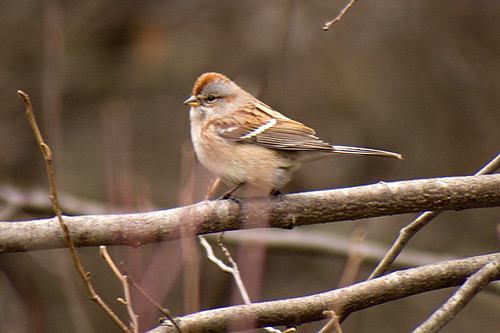
There were snow flurries in the air while taking my walk around Red House Lake today. I was glad to see many of the common LBJ’s around but there was significantly less waterfowl observed. Highlighted birds include 9 American Tree Sparrows, a Song Sparrow, 17 Cedar Waxwings and a late Woodduck down on the Maintenance Road.
I plan on giving Owl banding a try this evening with north western winds. I will let you know how the evening turns out.
Shot Gun Season Started Today!
I absolutely expected to stay inside due to this being the first day of shotgun season. You guessed it; I had this unexpected desired to get out of the house to do some birding. I located a few ducks after a quick trip over to Red House Lake (2 Horned Grebes, A zillion Canada Goose, 2 Common Mergansers, 4 Buffleheads, 3 Ring necked Ducks, and 4 Hooded Mergansers).
Highlight of the day was this Belted Kingfisher fishing from a branch near the beach. I took numerous photos framed perfectly but nothing turned out because the day was cloudy and dark (should have changed my ISO’s). I am starting to dream about what Allegany State Park looked like with the sun out!!
Returning from the grocery store I locate a male Ruffed Grouse crossing the road. I took some wonderful photos but with only 1/20th of second shutter everything turned out blurry. I promise that I will do better tomorrow with my camera’s settings!

Since I was unable to take any pictures today, here is a shot of this White-tailed Deer from this summer. Make sure you run my furry apple eating friend!
Following the Pot of Gold
A rainbow appeared around 3pm today after a constant 20 hours of rain. I just needed to open my windows due to temperatures being above average (71.2°F) and I wanted my cats to get some outside smells. I had full intentions on going to Wal-Mart for some needed groceries but something told me to try to find that gold (or fluff ball) at the end of that rainbow!
 Photo taken by Birdmom in mid October during the Camp Flicker Event.
I have found myself reenergized after the opportunity of meeting Scott Weidensaul yesterday. We had some wonderful discussions on owl banding and I feel it helped me remember how important it is to get out each evening to study these owls.
As the sun started to set, I started asking questions like “will I continue to capture birds later than the previous two seasons”, “Could birds still be hanging around” or “could I capture any new birds tonight”?? All questions which I anticipate answering after another wonderful warm evening.
On my first net check there was a recaptured Northern Saw-whet Owl from a few nights previous but with this rain there weren’t any surprise that it was still hanging around. I did not expect that newly captured bird caught only minutes before a mini rain storm that hit. This has been my 31st bird this season. During the 4th hour of operation the nets were closed due to a larger storm that started to approached from the south. Thank goodness for nexrad radar for giving me the heads up on this storm.

It’s so hard to believe that snow and more rain is predicted for the next few evenings. I saw numerous Redbacked Salamanders running along the the leaves and logs while closing my nets. It almost feels like April Showers without any of the May flowers. I don’t expect to open again until next Monday or Tuesday!
FYI: I would like to thank my friend Bill Adams who blogged one of my owl photos from this site. Please check it out at: http://billadams.net/billblog/?p=70
Scott Weidensaul Returns to Wild America

On Wednesday author/ornithologist Scott Weidensaul spent the day speaking to many guest and members of the Roger Tory Peterson Institute in Jamestown, New York. I have had numerous communications with Scott via email due to my Saw-whet Owl studies here in Allegany State Park. I found it a pleasure in finally meeting him in person. I recommend that you take the time to read his book “Living on the Wind” which has won the 1999 Pulitzer Prize. I love this book so much that I have quoted the “studying bird migration by the full moon” info in my Mon@rch Nature Blog.
Scott currently has numerous bird banders and volunteers involved with his Northern Saw-whet Owl banding project. Currently he oversees 3 banding stations located across southern Pennsylvania and has had a very low number of captures this season. We were comparing our numbers of owls, mice heard and of course this wet weather. I hope Scott is correct with his prediction that next season will be an irruption year for these little fuzz balls. During the “meet the author” reception, Scott discussed what genetic studies his team has been looking at across North America, some radio telemetry work being done in Pennsylvania and discussion on how he is using this information to better understanding the nomadic behaviors of these owls.
Scott continued in his discussion on some of his other studies involving western hummingbirds that have showed up across the eastern North America. He described some of the theories on why this has started to occur and what it means for those rare species that are regularly visiting people’s hummingbird feeders.
Further discussions reveled that Scott is also very interested in herpetology since childhood. I feel very fortunate to learn about an experience he had with a Milk Snake and the proper ways of grasping these snakes.

The main lecture was focused on his new book “Return to Wild America”. In 1953, Roger Tory Peterson and British Ornithologist James Fisher adventured down the east coast starting in Newfoundland, across the Florida Keys into Mexico, then up into Alaska. Scott followed this North American tour exactly 50 years after these two renowned naturalists took the trip and Scott was successful in describing the changes (good and bad) which have occurred over those 50 years. He showed a beautiful slide program with descriptions on how the two adventures were similar and different. I will let you read the book to hear some of those stories but you had to be there to experience the sound effects he vocalized and his discription of visualizing some sausages he saw out on the beach. I enjoyed this slide program and suggest that you take the time to visit him when he speaks at a Nature Center near you.
Overall, Scott was a very kind hearted individual and I would have loved to spend some time out in the field with him. He autographed my book with “For Tom, a fellow Saw-whet Nut – keep sending them south!”. You can purchase his book at Amazon.com to read more about his adventure.


Next author being scheduled at the Roger Tory Peterson Institute is Bill Thompson III (still unsure the date and time). Bill is the current owner of Birdwatchers Digest and both Bill and his wife (Julie) are wonderful “entertaining” speakers. I recently learned about their blogs at Bill of the Birds and Julie Zickefoose blog and plan on visiting these blogs on a daily basis. I am lucky to say that I have had the opportunity to meet both of them on numerous occasions. The family has gone camping here in Allegany State Park during the Allegany Nature Pilgrimage and I have run into him at a few conferences that I have attended. I expect this to be equally entertaining program and I hope you are able to attend.
A Northern Saw-whet Owl – November Surprise
Friday evening after 11 hours of banding, the Allegany State Park station had one of its best nights. What I don’t understand was that Thursdays evening also had equally nice winds (from the north) but we didn’t catch any owls. The different I did notice between the two nights was that birds normally moving south were observed in the NEXRAD radar moving in a westerly direction.

Within the first 4 hours of operations we had banded 7 newly captured birds and there was no doubt that I wouldn’t be going to bed until 5am in the morning. Winds were calm from the North East and then slowly shifted to the South East as the evening progressed. I had decided to close early due to a slow spell that appeared to be developing. But I have this simple rule that when you catch an owl, the nets must stay open for another net check. It wasn’t until 4:15am that I got my first opportunity to close and head to bed. I seriously considered doing an all nighter but the winds really started picking up and there was a big storm closely approaching. It was time to close everything up and head to bed.
Catching 11 individuals for the night is the stations new record!! Overall the station banded 9 new birds and 2 additional individuals originally banded 15 days ago during the Perfect Fluffball Night. The one recaptured bird was our friend from earlier in the week (Nov 6 ) which had lost 10.3grams!! Over the past 4 nights this bird has gained back 2.2grams. The other recaptured bird which I had originally banded 15 days ago had lost 5.2 grams (which is almost 6% of its body weight).
Questions that I begin to ask after looking at the data include: Are these two young birds local birds which have no intention on migrating south? Were they hatched late in the season and not ready to start moving yet? Could these birds have arrived at their current wintering grounds? Is it possible that due to weather these birds have located a stopover site and will continue migration in the near future? I hope that over time that we can answer these questions and get a better understanding of these birds Natural History. All I can hope is that my neighboring banding friends catch these fluff balls at their station!!
FYI: Many banders across the North East have been reporting this owl season being one of their worse season in 10 or more years. I have not had the consistent captures like last year but I have had 2 “BIG” nights which have taken me over my previous two year’s numbers (birds per net hours and individuals captured). The best part is that my season isn’t over yet! Check back to Mon@rch’s Nature Blog for learning how my season continues. (I think its time for a nap)!!
Its your right to vote!

I can’t believe its election day and I am doing a political blog. Don’t forget to get out and vote!
I located this Bald Eagle on the eastern side of Red House Lake here in Allegany State Park. I figured this was a very appropriate bird on a day like today.

A few new and one old friend
I caught three owls tonight. The first was around 7:30ish and boy what it cute. I then needed to do a quick trammel line fix after a flying squirrel did some chewing, grrr. While spending a little time mending, I heard a Northern Saw-whet Owl vocalizing just above me. I quickly finished tying the line and got out of there as quick as I could. Next check there was that fluff ball in net B7. This was a recaptured bird that I originally banded 11 days ago (during the Perfect Fluffball night). Over the past 11 days this bird lost 10.3grams which turned out being 9.8% of its body weight. The last capture was a new bird around closing. Radar showed a decent movement of birds this evening and many stations along the east coast are finding similar results.
Other bird news: While out banding ~ 9:30ish (EST) there was a large flock of Tundra Swans flying overhead. It appears their migration has started!
Full Moon and Apple Fritters
Tonight was a good night at the Allegany State Park Owl Banding Station! I had that feeling things were going to be good as soon as my neighbor dropped off some Apple Fritters just because they had a little extra! I was happy to thank them with a phone call around 7:30pm asking them if they would like to see a foreign recaptured owl that I had just caught. This Northern Saw-whet Owl was previously banded two years ago in Ontario Canada (thanks to quick database response from the Bird Banding Lab). It will probably be a few days before I learn more about this owl’s previous capture.
This is this stations second ever foreign recaptured bird and both have come from Ontario Canada. What is also ironic is that both birds have been caught in the fall during the official “full moon” night. Tonight’s bird was caught with dark clouds covering the moon where the other bird was caught during the darkest part of a lunar eclipse.

Radar shows very little movement of birds and this might be due to bad wind direction.
Night with almost a full moon

This evening I had a visitor from the Buffalo area with hopes of catching a Northern Saw-whet Owl. Of course we didn’t catch any fluff balls but we did recapture that Barred Owl from earlier last month (Unusual Visitor). What was interesting was that this bird lost just over 100 grams from its last capture (~7.5% of its body weight). We both agree that it was exciting to watch it flying up into the tree (backlit by the moon), turn around to look back at us and then fly away! I regret not having my camera with me!!
I would like to thank Jerry for putting up with my numerous bird quizzes and me being me!!! I would also thank you for the Sliced Cream Cake that you left here! Hmmmm! I hope next time we will be very busy banding Owls and I would love to break that 10 bird night record!
Radar did show a little movement of birds but the winds were from the south and there might have been some rain disturbance across WNY. As discussed in previous moon blog (full moon bird observations), the capture rate of owls isn’t good when the moon is out. I think having snow on the ground with no leaves made everything appear much brighter than last month’s full moon. I wouldn’t be surprised if I don’t catch any owls for the next few nights.


Today was a very pretty morning with a light layer of snow on the ground and the sun out! For good bird news, I had my first of the fall Ring-neck Ducks and Pied-billed Grebes in Red House Lake. I also might have seen my first of the fall Tree Sparrows along Rt. 2 but didn’t have my binoculars to confirm the sighting. It shouldn’t be long before I start to see them everywhere.
I am off to bed and I hope my next blog reports capture of some fuzz balls.
Bird Suet for your Backyard Feeder
Beef suet can bring in 80 species of birds into your backyard including woodpeckers, catbirds, mockingbirds, nuthatches, chickadees, titmice, wrens, orioles, shrikes, thrushes, warblers, grackles, and starlings (Ehrlich, et. al. 1988). There are many different kinds of suet mixes out in the market today like “berry”, “fruit”, and even “insect” cakes. Long before bird food became a billion dollar industry, birdwatchers would use raw beef fat from around the kidneys and loins. I prefer making my own suet using the standard peanut-butter mix.


Some things you need to remember about suet, is that if the temperature outside is around 70 degrees Fahrenheit or warmer, beef fat can turn rancid and melt. Sometimes this warm suet will mat feathers, which can result in reduced insulation and waterproofing to the bird. So be sure to use commercial suet cakes called “no melt” in warm temperatures.

Below are some recipes for making your own suet cakes:
Beef Suet:
- You can trim excess fat off beef cuts and store in the freezer until enough fat is achieved or you can purchase beef fat from the grocery store or your nearby butcher. Grind the beef fat with a meat grinder or finely chop the fat. Heat the fat over a low to medium flame until it’s liquefied. Strain by pouring melted suet through a fine cheesecloth. Let cool to harden. Repeat steps of heating and straining because if the fat is not rendered twice, the suet will not cake properly. Let cool to harden and store in a covered container in the freezer.
Standard Suet:
- You need: 1 pound lard, 1 cup crunchy peanut butter, 2 cups quick cooking oats, 2 cups cornmeal, 1 cup all purpose flour, 1/3 cup sugar, and 1 cup raisins. Melt lard and peanut butter together over medium heat. Remove from heat and stir in the remaining ingredients. Pour into molds or containers suitable for your suet feeder. Be sure not to exceed 1 to 1 1/2 inches in thickness. Allow to cool completely. You can wrap the suet cakes in wax paper and store in the freezer until ready to use.
Ehrlich, P.R., David S. Dobkin, and Darryl Wheye, 1988 The Birder’s Handbook, A Field Guide to the Natural History of North American Birds, Simon & Schuster Inc.
** I wrote this back in 2001 for another nature center that I worked for and wanted to make sure it was in the blog (this is the time of the year I start making suet and needed easy access to the receipt). I also learned recently on Squirrel Style that there is also a Red Hot Pepper Suet which keep out the Squirrels! The individual who made the comment gave me this link! – Peanut Pepper Suet ~ 12 cakes
New Animal Sounds Website
Mon@rch News

Cornell Lab of Ornithology has recently released a new free website on the world’s largest collection of animal sounds. Animal Behavior Archive
I have found this site to be very user friendly and extremely valuable to anyone who needs to better understand the natural history of any particular species. I did a simple search of my all time favorite Gray Treefrog (Hyla versicolor) with 13 results:
Here is the first Record # 85162 (link no longer works so I broke it) I found in the search! No longer working so here is my own photo and audio link.

I recommend everyone to visit this site and take the time to learn about those special sounds you have always been curious of (like maybe a Rhinocerous or Seal).
Other sites provided by the Cornell Lab of Ornithology include:
Birdflu updates – Location to learn about updates of the Avian Bird flu!
All About Birds – Location to Learn about Birds!
E-bird – Location to Store all your Bird Data!
Happy Halloween!
Halloween is the time for the hunted ghost, goblins and critters that move through the night! As a kid, I remember getting dressing up and begging for candy from my neighbors. Once older it was my job to assist my mother in giving away candy to the up and coming little trick or treaters. For the past few years I have moved away from the candy business and spend my time better undstanding the soft feathered owls moving through the sky (which are the halloween spooks).

Tonight I was not expecting any owls due to southern winds, clear skies and the bright moon. Radar showed very little bird movement and conditions were not good at all. This was a true Halloween treat during my second net check locating a fuzzball. There was no other activity the rest of the night except at the strike of midnight!! I ended up with a little brown bat in my net (happy Halloween to me, grrr). Thank heavens for thick gloves and rabies shots!

My Nephew going Boooo!!
*** I would like to thank my friends from Ontario Canada for visiting the banding station yesterday. I was able to call in an Eastern Screech Owl for them but I was not able to band owls due to very high winds and rain from the previous night. Lets hope that on their next visit that the nets will be full of little fuzz balls for them.
Largest Bird in the World Discovered
Mon@rch News:
While listening to NPR radio yesterday, I learned that an Argentina teenager discovered a near complete skull and leg bone of the largest bird in the world. This skull places this newly found species in the phorusrhacid family which scientists are calling the “terror bird”.
It was published in the Journal “Nature” (volume 443, page 929) that this flightless bird was about 3 meters tall with its head about the size of horse. This species had the speed of a grayhound dog. The Terror Bird survived about 60 millions years after the death of the dinosaurs. It was one of the largest predators dominating the grasslands of South of America and survied up to about 2 millions years ago. For more info be sure to check out the following links:
Giant Terror Bird was light on its feet – New Scientist


 Mon@rch's Nature Blog