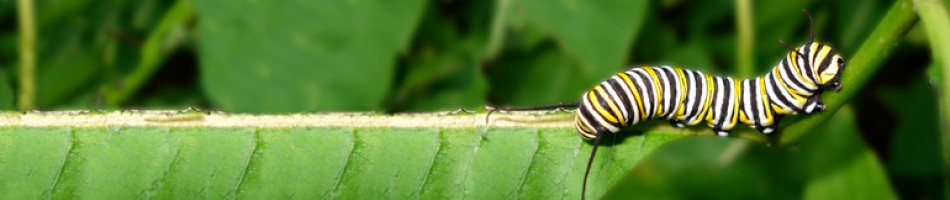
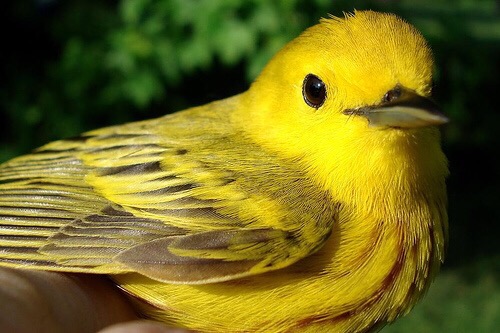
I have been banding birds for 18 years and I would like to start a series on my recapture birds that I have encountered during my banding carrier. The first bird that I would like to share is the Yellow Warbler.
Latest
The “Warbler Guide” [App Review]

I have been giving the opportunity to review the “Warbler Guide” App that is available with my iPhone/iPad. The Warbler Guide “book” that this app follows is not something you would carry with you on every birding adventure. However the two together complement each other really well. The book gives you more of a text book description of each species; the app appears to be a more field identification guide. My favorite feature of the App is that it’s always accessible when needed and then look up the other info in the book later when you get home. Read the rest of this page »
Merry Christmas 2014
Happy Holidays everyone.

A Few More Birds from Dunkirk Harbor
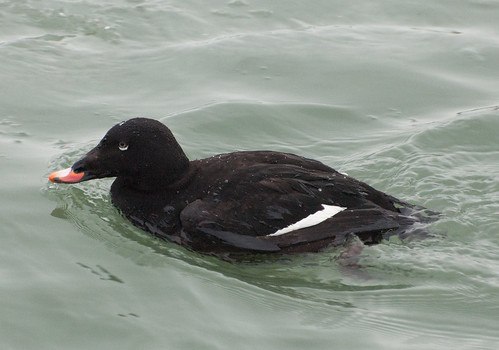
White-winged Scoter
By: Pat Coate
The pictures in this post were taken at Dunkirk Harbor this past winter.
In our area, the white-winged scoter winters on Lakes Ontario and Erie. It is becoming a bit more common due to the invasion of the zebra mussels, as mussels (and clams) seem to be one of its favorite foods.
Dunkirk Harbor
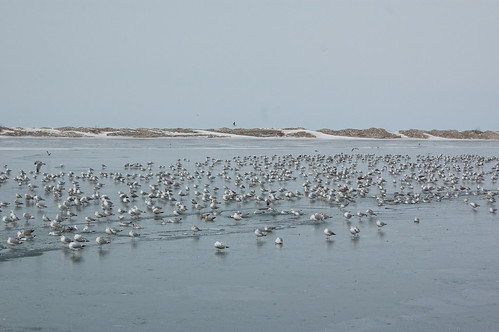
Gulls
By: Pat Coate
During our unusually harsh winter in Western New York open water for ducks and gulls was hard to come by. Dunkirk Harbor on Lake Erie usually has a good bit of open water due to warm water discharge from the nearby power plant. But with the prolonged cold spell even the harbor had very limited open water this year, making competition for food fierce.
Brecon Beacons, Wales
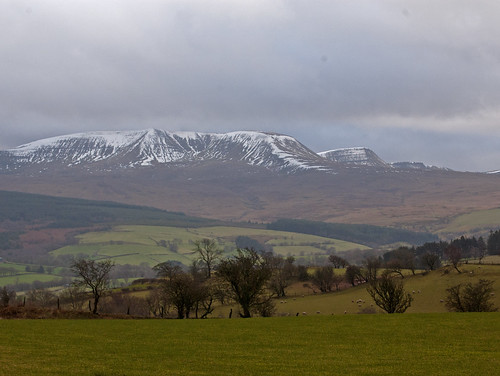
Brecon Beacons
By: Pat Coate
Brecon Beacons is a national park on the border of South Wales and Mid Wales. Its highest peak, Pen Y Fan (2907′), is also the highest mountain in southern Britain.
Long-eared Owl
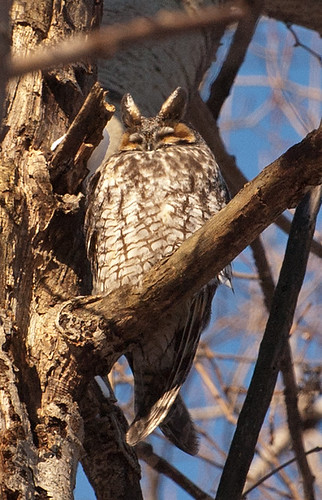
Long-eared Owl
By: Pat Coate
This long-eared owl was another life bird added to my list with grateful assistance from Jim Adams (http://ayearinoatka.blogspot.com/). The owl was seen at Oatka Creek Park, Monroe County, NY.
The prominent ear-tufts give the long-eared owl a similar appearance to the great horned owl, though its tufts are more towards the center of the head than the great horned owl. Also the long-eared owl is much smaller (15 v. 22 inches) and has a more slender build.
Virginia Rail

Virginia Rail
By: Pat Coate
Many thanks to Jim Adams (http://ayearinoatka.blogspot.com/) for recently helping me add a couple life birds to my list. One was this Virginia Rail, seen at Mendon Ponds Park near Rochester, NY.
Normally a secretive bird, this one was easier to find than usual due to a shortage of open water this winter. Virginia Rails feed by probing shallow water and mud for insects, fish, frogs and other aquatic animals. The small area of open water where it was forced to feed is near a hiking/cross country skiing trail in the park which allowed for unusually good views.
Read the rest of this page »
Some birds of St. James’s Park, London

White Pelicans
By: Pat Coate
While in England traveling with my daughter we spent a day in London. We took the train into Waterloo Station and spent the day walking all over taking in the sights – Parliament, Westminster Abbey, Big Ben, Buckingham Palace, The Eye, Piccadilly Circus, the National Gallery, and Trafaglar Square. Despite a February visit, London was filled with tourists and vacationing English families (schools were on break). Despite the crowds, London’s parks were full of wintering waterfowl side by side with the captive exotic waterfowl. These pictures were all taken at St. James’s Park.
King James I, in the early 1600s, was the first to keep exotic waterfowl in the park. White Pelicans arrived in 1664 as a gift from the Russian ambassador. The pelicans are looked after by wildlife specialists, receive a daily feeding, and are quite friendly. Other exotic waterfowl we saw included Black Swans and Red-crested Pochard.
In Search of Robin Hood…Robins and a couple other birds of Sherwood Forest
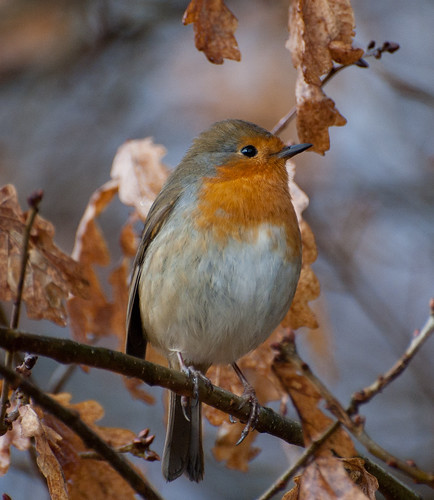
Robin
By: Pat Coate
Had a marvelous opportunity to spend two weeks in Great Britain traveling with my daughter. One stop was in the Sherwood Forest/Nottingham area – the land of Robin Hood. Whether fact or fiction, we had lots of fun walking through hallowed Sherwood Forest, visiting Nottingham Castle and Ye Olde Trip to Jerusalem, and checking out Edwinstowe where legend has it Robin Hood married Maid Marion.
Though certainly not a main purpose of the trip, there were many wonderful birds along the way and it would have been a shame not to try to capture a few photos. One bird we saw throughout was the Robin – a very cheery, friendly bird. It is much smaller and daintier than our American Robin.


 Mon@rch's Nature Blog