
A few new and one old friend
I caught three owls tonight. The first was around 7:30ish and boy what it cute. I then needed to do a quick trammel line fix after a flying squirrel did some chewing, grrr. While spending a little time mending, I heard a Northern Saw-whet Owl vocalizing just above me. I quickly finished tying the line and got out of there as quick as I could. Next check there was that fluff ball in net B7. This was a recaptured bird that I originally banded 11 days ago (during the Perfect Fluffball night). Over the past 11 days this bird lost 10.3grams which turned out being 9.8% of its body weight. The last capture was a new bird around closing. Radar showed a decent movement of birds this evening and many stations along the east coast are finding similar results.
Other bird news: While out banding ~ 9:30ish (EST) there was a large flock of Tundra Swans flying overhead. It appears their migration has started!
Bird Suet for your Backyard Feeder
Beef suet can bring in 80 species of birds into your backyard including woodpeckers, catbirds, mockingbirds, nuthatches, chickadees, titmice, wrens, orioles, shrikes, thrushes, warblers, grackles, and starlings (Ehrlich, et. al. 1988). There are many different kinds of suet mixes out in the market today like “berry”, “fruit”, and even “insect” cakes. Long before bird food became a billion dollar industry, birdwatchers would use raw beef fat from around the kidneys and loins. I prefer making my own suet using the standard peanut-butter mix.


Some things you need to remember about suet, is that if the temperature outside is around 70 degrees Fahrenheit or warmer, beef fat can turn rancid and melt. Sometimes this warm suet will mat feathers, which can result in reduced insulation and waterproofing to the bird. So be sure to use commercial suet cakes called “no melt” in warm temperatures.

Below are some recipes for making your own suet cakes:
Beef Suet:
- You can trim excess fat off beef cuts and store in the freezer until enough fat is achieved or you can purchase beef fat from the grocery store or your nearby butcher. Grind the beef fat with a meat grinder or finely chop the fat. Heat the fat over a low to medium flame until it’s liquefied. Strain by pouring melted suet through a fine cheesecloth. Let cool to harden. Repeat steps of heating and straining because if the fat is not rendered twice, the suet will not cake properly. Let cool to harden and store in a covered container in the freezer.
Standard Suet:
- You need: 1 pound lard, 1 cup crunchy peanut butter, 2 cups quick cooking oats, 2 cups cornmeal, 1 cup all purpose flour, 1/3 cup sugar, and 1 cup raisins. Melt lard and peanut butter together over medium heat. Remove from heat and stir in the remaining ingredients. Pour into molds or containers suitable for your suet feeder. Be sure not to exceed 1 to 1 1/2 inches in thickness. Allow to cool completely. You can wrap the suet cakes in wax paper and store in the freezer until ready to use.
Ehrlich, P.R., David S. Dobkin, and Darryl Wheye, 1988 The Birder’s Handbook, A Field Guide to the Natural History of North American Birds, Simon & Schuster Inc.
** I wrote this back in 2001 for another nature center that I worked for and wanted to make sure it was in the blog (this is the time of the year I start making suet and needed easy access to the receipt). I also learned recently on Squirrel Style that there is also a Red Hot Pepper Suet which keep out the Squirrels! The individual who made the comment gave me this link! – Peanut Pepper Suet ~ 12 cakes
New Animal Sounds Website
Mon@rch News

Cornell Lab of Ornithology has recently released a new free website on the world’s largest collection of animal sounds. Animal Behavior Archive
I have found this site to be very user friendly and extremely valuable to anyone who needs to better understand the natural history of any particular species. I did a simple search of my all time favorite Gray Treefrog (Hyla versicolor) with 13 results:
Here is the first Record # 85162 (link no longer works so I broke it) I found in the search! No longer working so here is my own photo and audio link.

I recommend everyone to visit this site and take the time to learn about those special sounds you have always been curious of (like maybe a Rhinocerous or Seal).
Other sites provided by the Cornell Lab of Ornithology include:
Birdflu updates – Location to learn about updates of the Avian Bird flu!
All About Birds – Location to Learn about Birds!
E-bird – Location to Store all your Bird Data!
Largest Bird in the World Discovered
Mon@rch News:
While listening to NPR radio yesterday, I learned that an Argentina teenager discovered a near complete skull and leg bone of the largest bird in the world. This skull places this newly found species in the phorusrhacid family which scientists are calling the “terror bird”.
It was published in the Journal “Nature” (volume 443, page 929) that this flightless bird was about 3 meters tall with its head about the size of horse. This species had the speed of a grayhound dog. The Terror Bird survived about 60 millions years after the death of the dinosaurs. It was one of the largest predators dominating the grasslands of South of America and survied up to about 2 millions years ago. For more info be sure to check out the following links:
Giant Terror Bird was light on its feet – New Scientist

Grouse Displaying
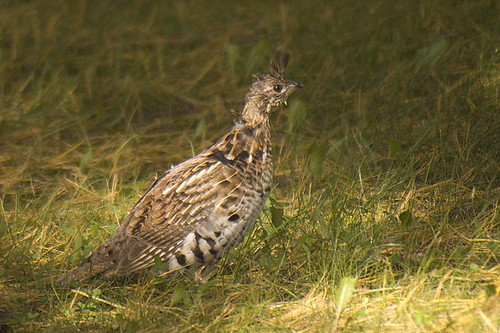
I have never seen so many grouse as I have just before the start of Grouse season. While getting out of my truck for a closer photo, this grouse started to display.


Suddenly the male Ruffed Grouse took off and stopped my heart from whizzing past my head. Now all relaxed, I started to walk towards the tree (saw a feather on the ground and wanted a closer look) and then my heart stopped again! There was a female behind the tree which I didn’t realize was there. What a wonderful life I have.
Basement Vistor
One of the Park Naturalist brought this little critter to my office and notified me that he had just caught it in the basement. For a short time we were identifying this as something else until PG (who was babysitting it) said “its brownie” pointing to its picture in the field guide! After going through all the keys and reading up on it – she was correct that this little mouse was a Meadow Jumping Mouse Zapus hudsonius.

Some interesting details that we learned about brownie was that it should have much longer hind legs than its front legs, its tail is twice as long as the body and fur has an interesting yellowish brown (almost red highlights) to it. This mouse does resemble the Woodland Jumping Mouse but doesn’t have the white tipped tail like the woodland species has. Some other interesting facts that we learned is that its first jump is about 2-3 feet and then follow with smaller hops (which made it hard for the Naturalist to capture – I would have loved to watch the capture). I really found interesting is that this species will go into hibernation from late October to Mid May (for over a ½ year). Just remember that these mice are food to the many other animals that we love to photograph! It’s a mammal that we rarely see being that they are most active at night and sleeping most of the year. After observing this little mouse in the office we released it over on the other side of the lake with hopes to making many more baby mice.

The Day of Exploring New Territory

Common Garter Snake (Thamnophis sirtalis)
This was a wonderful day today! Weather was perfect and I was given many photograph opportunities. I was invited to join two inspirational biologists in search of some fall wildflowers in an area of the park that I have never explored before. Here I would like to include a few other photos from our hike trip up into the woods.


These two flowers (Zigzag Goldenrod and Crooked-stem Aster) were located along the forest edge. They both have that Zig n Zag feel to them and its ironic that they were growing together. The Zigzag Goldenrod was a wildflower that I never took the time to identify until this trip.

This Magnolia Warbler was showing off its yellow coloring which let me get a quick photo or two before disappearing into the shrubs. There were a few Magnolia’s flying around but most of them were high up into the canopy. Some Common Yellowthroats, Chickadees and a Thrush species was in the same area with the Magnolia.

While leaving, we came across this Green Heron in the wet grass while searching for some shorebirds. Was wonderful it would pop its tuft up and get a grasshopper or two. We were lucky to have watched it for about 4 minutes before disappearing into the grass.
Nodding Ladies’ Tresses Orchid (Spiranthes cernua)

While checking out the other wildflowers – we happened to come across these Nodding Ladies’ Tresses Orchid Spiranthes cernua!! They are such interesting looking Orchids with the flowers spinning around in spirals. The pictures tell it all!


Young Woodturtle Found
Found a very tiny Wood Turtle Clemmys insculpta along the Horse Trail here in Allegany State Park. No one in the group had seen this species this small before. Its measurements was 110mm by 80mm which is very tiny (check this photo Adult Woodturtle to see the typical size that I see them). Also, this turtle had an older cracked shell incident which we are guessing was caused by a horse stepping on it (shape and size). It is probably a few years of age and appeared to have survived the accident with the cracked shell (starting to grow together). But, this turtle did have paralyzed hind legs and would drag it with its front legs!


Closed Gentian
Here is Closed Gentian which the purple or blue flower is commonly found here in AlleganyState Park in the woods or wet meadows.


This flower is unique that there is a white form of this plant. An interesting fact which we learned about Closed Gentian is that the only insect which can successfully pollinate this flower is the bumblebee (Flora of Michigan). We are double checking to make sure this isn’t a different species but its leaning towards being the white form of Closed Gentian.

Deer More Interested in Apples than Me
These White Trailed Deer let me walk right up to them and take their picture! I do get to see the deer feeding on these apples quite often but these really did not care that I was there.


Movement of some Northern Ring-necked Snakes
Was an interesting day today! Heading back to work from my lunch break – I located a Northern Ring-necked Snake in the middle of the road. Took a few pictures and then let it go! What was so interesting was that another one of these young Ring-necked Snakes were found inside the administration building. It obviously was a different individual by the amount of orange ring around its neck and the first one looked like it was going to shed soon. Just can’t figure out where these snakes are coming from??


I did let both of them go in the direction towards the picnic area.
Dogwood Berries is good source of food!
I have been seeing many birds recently feeding on the Dogwood Berries along the bike path here in Red House!! Here are some of the birds that I observed:
Red Eyed Vireo


Yellow-rumped Warbler (note its banded and probably one of my birds)


Lots of fruit in the forest for both birds and other wildlife! Do keep your eyes open!!
Is that a….. your kidding me…..
I can now say to expect the unexpected here in Allegany State Park. Today we had an unexpected visitor here at the Administration Building which got trapped in one of our window wells (probably at night sometime). Don’t ask how a mammal that lives in the water ends up in a location like this (up a hill, behind a building and quite a distance from water) but this is proof that it can happen. Typically we get a toad (wait, there already is a toad in there), salamanders or even a snake stuck in these wells. Mammals typically are able to climb out or they might decide to climb in and eat these other critters. This window well was just a little too tall for this beaver to climb out. Luckly P.G. happened to be out for a cigarette break and heard a noise!

Trapping wasn’t easy be we were able to get this beaver into the trash can. The officer that assisted ended up with some beaver scat on his leg (whoops). We were quickly off to the lake to be released. Of course, it didn’t take long for a crowd to show up excited to see the release. Once we opened the can the beaver slowly walked out and headed right to the creek which empties into Red House Lake this location.

Once in the water the beaver got very low and tried getting as much of its fur wet as possible (creek water was shallow). It then headed down the stream dtowards the lake (moved must slower than I had expected).

When the beaver made it over to deeper water – it took a small dive and then ended up in the middle of the lake in about 10 seconds! I would like to wish our beaver friend good luck and a fun adventure very away from buildings!
Bear Visit
Today the weather temp was a high of 86.2F and Low of 54.6F. About 8:30pm there was something that just told me to get up and look outside. What I found was a HUGE black bear that is probably around 200 pounds. It was checking out my grill which I had cooked hamburgers earlier. It then started climbing the tree and eating some sunflowers from my squirrel proof feeder (notice I said squirrel proof). Typically I take this down each evening but this guy beat me to it!! Ugg, Anyways, I started scrambling getting my camera in order to try and take some pictures! Of course, my screen door just kept on making the pictures look goofy but I did luckily get a shot in.

Not long after taking the picture, the bear got startled and climbed down the tree. It circled the tree and the bear started coming towards my screen door. I was probably about 5-7 feet away when I slammed the heavy thick door which in turn got the neighbors dog barking. This startled the bear and up into the woods it ran.

I believe that this bear started coming towards the house thinking I was going to give it handouts! The problem is that too many people try feeding the bears. Although I was very close to the bear, I was safe for the fact that I was able to close the door where it couldn’t get me. People don’t always have that opportunity and chance that the bear could turn on them. Just seeing a huge mammal like this had my heart pumping and was an amazing rush! There is just nothing like that experience!! So, if you do come across a bear in the wild, please don’t try to feed it! Making noise typically is enough to scare it away.


 Mon@rch's Nature Blog