My life is about living with nature – here you can live it with me!

Latest

An unusual visitor at the banding station

Barred Owl

The Barred Owl (Strix varia) is a year round resident who doesn’t migrate like the Northern Saw-whet Owls.  They have a very large 42 inch wingspan and a very rounded head. I hear many more Barred Owls than those I get to see.  Their very well known for their calls in the middle of the night which sounds like “hoo hoo ho-ho, hoo hoo ho-hoooooaw” or also known as “who cooks for you, who cooks for you all”.   Bents life history series of books mentions that they are more diurnal than nocturnal but I guess that depends on the neighboring food supply.

barred owl

I have had these owls in my nets before but they always seem to get out before my opportunity to band them.  The banding team took no chances in giving this owl a chance to get out. This is an adult bird which I was unable to determine its sex!  You can be sure that everyone at the station was extremely excited once we realized what we had just captured. As you can see they are very large in size compared to the tiny N Saw-whet Owls that we are use to handling.  The moon was bright and we truly didn’t expect a saw-whet (which I should mention we also captured) yet alone a Barred!

7 oct 2006 front 

As you can see, most of the movements of birds were mostly along the eastern side of New York and New Jersey! Althought there was some movement across all of the North East.

Full Moon Bird Observations

Tonight is the official “Full Moon” and there are no owls in sight.  A fun project to do when the moon is full is to set up a telescope and sit back to continue to watch the moon for a straight hour. While watching, be sure to count the number of birds you see (yes you will see them moving) and then there is some math that will help you determine the number of birds moving over your location.  It will truly amaze you once you start to add all the numbers together!!  You can then look at the radar and you will be able to see about the number of birds flying in the sky all at the same time across the united states.


For the math, I took this info from the “Living on the wind across the hemisphere with migratory birds” page 30 by Scott Weidensaul;   if you were to average four birds per ten minute block of time in PA of course, the moon’s disk is only a fraction park of the sky, but it represents that cornerstone of science, a random sample. If you were to draw a line from the horizon to horizon, the full moon covers about half degree of the night sky along it – 1/695 or a circle, or 1/347.45 of the visible sky, to be more precise. To estimate the number of birds passing, I simply multiplied my average of four birds by six for the hour, then multiplied those twenty-four songirds by 347.45. According to my observations, about 8,349 birds should have passed within few of my twenty power scope – a span about a mile and a half wide during that one hour.    


Now, the location he is discussing wouldn’t be in a major migration location along the gulf coast or Cape May. Those numbers would increase drastically if you only saw one or more bird(s) per 10 minute block.  Let me know if you give this project a try.  

6 oct 2006 nexrad

Radar shows a strong movement of birds again tonight with perfect calm NE winds and clear sky.

How to have fun when there are no Owls

moon shadow

I have some friends staying over at Cain Hollow for Columbus weekend and this photo was from my trip home just before opening my nets for owls. Obviously from this photo you can see the moon is very bright and almost “Full”. We are not exactly sure why but it is assumed that the reason Owl banders don’t catch many owls during full moon nights is that the Owls are able to see the nets. So, obviously we didn’t catch any owls but we made the best of the night.

The kids were very spontaneous when on camera but I think everything worked together alright. (BTW: We didn’t see the aurora but the fog almost looked as if it was really the northern lights, I took that photo from the web somewhere).

5 oct 2006 nexrad

Radar showed a strong movement of birds tonight with perfect calm NE winds and clear sky!

How to observe migration at night

Most people don’t realize that birds migrate at night starting at sunset.  Numerous studies show that songbirds use their constellations to navigate their movement to their desired location. On cloudy nights they can use the small opening of the sky or correct themselves once the sky opens again.  The amount of daylight is what triggers these birds to start moving and today there are many new methods that Ornithologist are using to study their migration.  Currently, Powdermill Nature Reserve is conducting a bioacoustic study where they are collecting nocturnal flight calls made by these birds, which allow them to survey which species are moving through the area.  For more info, check out the Powdermill page at: http://www.powdermill.org/research/bioacoustic.htm


I am an amateur weather observer and been “trying” to use NEXRAD radar to assist me in banding these little owls. As you’re aware, NEXRAD radar is an important tool for meteorologist in following rain and snow storms that are in the area.  If you listen quietly while checking the nets for owls, you can hear the call of these birds moving overhead.  Then you know to check the radar to see what is truly going on.  Now because the NEXRAD radar is so sensitive, it can pick up the movement of insects, bats and even dust that is in the air.  Typically meteorologist call those spots observed on the radar “ground clutter”.  In the fall and spring we call those spots “bird migration”.  I choose to use the Weather Underground website located at http://www.wunderground.com and I decided to pay the membership to receive the longer images.  If you use the NEXRAD Storm Velocity feature, you will observed the “ground clutter” (after sunset) moving North in the spring and the movement South in the fall.  For most nights that I blog, I will be uploading images on the bottom of the radar collected from Weather Underground and if you click on the image – it will show the image moving!


nexrad 10 1 06

This first clip is from last night’s radar showing the movement of the birds from 8pm EDT to just after midnight EDT!  Yes, you’re looking at thousands and thousands of birds moving through Western New York  But, it is really hard to distinguish what direction its moving and if it could possibly be fog in the area.  For that you use the map below looking at the Storm Velocity.

nexrad 10 1 06 V

This is the same image but is showing the birds movement.  Green means it’s moving towards the radar (which is located in the center of the screen) and red means it’s moving away from the radar.  If you click on the link, you will notice that the movements of the birds are coming from the NW direction (moving towards the SE) and then as the evening progresses the birds start changing their direction heading due south.   Now if you think that’s cool, check this next map!

front 10 1 06

Here you see the front map of the North Eastern United States starting just before sunset.  Right at 7:30 the birds will start to appear at each of the NEXRAD radar stations and you can then get a larger perspective of how many billions of birds (aka: Ground Clutter) are moving at one time.  You probably can see why everyone finds this so interesting to learn about.  For more info on Radar Ornithology, please visit the Clemson University website (where I learned everything I know about this subject).  Below is the image from tonights radar where there isn’t much movement (you can see a little) but you are able to see some of the rain storm entering the screen in the upper left! 


2 oct 06 nexrad

Obviously, I didn’t catch any owls tonight with strong 10-15mph Southern winds and clear sky.

Start of the New Season

Tonight was the start of my Northern Saw-whet Owl studies here in Allegany State Park. This is my 3rd year out collecting data and I will be continuing this season’s studies for the next 6 weeks (so expect most of my blog reports to be about owls and bird migration).

Its all about the eyes!

There is very little information on the migration routes of the smallest owl found in New York State. The Northern Saw-whet Owl is a very secretive bird and has been overlooked for many years now. My goal is to get a better understanding of the fall migration in Allegany State Park, NY. With bird banding, we can better understand where these migrant birds nest and where they go for the winter season.

Northern Saw-whet Owl

These photos are of the first Northern Saw-whet Owl captured for the season. We call this a “hatch year” bird because it was a bird hatched earlier this summer. What was unique about this bird was that it’s late in going through its first prebasic molt (which is loosing its juvenal feathers into its first set of adult feathers). The picture above shows some juvenal feathers still in its body but its very close to looking like an adult bird. As the season progresses, I will show you ways that we identify the age of the bird (with a black light), different animals I encounter and the many other things that we can learn about these owls. I can’t wait to share with everyone how amazing these birds are.

Fall Foliage Report

Fall Foliage Report

This week the leaves started to really look like fall here in allegany state park.  I would anticipate that more leaves will start changing and dropping with our colder nights that we have been having. I recorded a low temp last night of 33.1 F which is the coldest so far this fall.   The 7th of October will be a full moon which will make the temperature drop with a few nights of frost. This September has almost been the rainiest September that has been ever recorded (so, yes I am still mowing the lawn).


This has been a report from Mon@rch your Fall Foliage Reporter for allegany state park, NY.  

Click here for a large size: static.flickr.com/92/256301317_3ed81ad158_b.jpg

Click here for a larger size: static.flickr.com/92/256301317_3ed81ad158_o.jpg

Fun Day With the Kids

Learning

Took a half a day off of work today to head over to the Elementary School to do a banding demo for 43 kids (2nd and 3rd graders).  Here are some photos from the wonderful day.  The 4 birds that I was able to capture were Ruby-throated Hummingbird, Common Yellowthroat, Gray Catbird and Gray-cheeked Thrush.


 Hummingbird Common Yellowthroat

Mist Nets Gray-cheeked Thrush The Nets


They just loved this kind of hands on experience!

Not Expected

Not much to say (after the grouse encounter) but I wanted to share this photo of the Shadow Darner that I was able to capture in flight.  I was chasing around some warblers (never did get any good photos) and found this dragonfly teasing me! Going back in time, I have been spending a great deal of time trying to capture any dragonfly in flight (without any luck).  Here, I took two quick shots and just went back to chasing those warblers.  Once I got home, I never expected to find this in the camera!


darner species

Grouse Displaying

Grouse

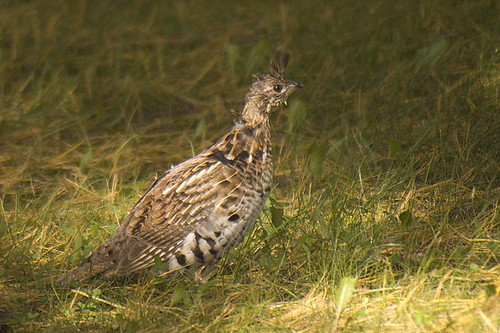
I have never seen so many grouse as I have just before the start of Grouse season. While getting out of my truck for a closer photo, this grouse started to display.


Ruffed Grouse Ruffed Grouse Ruffed Grouse


Suddenly the male Ruffed Grouse took off and stopped my heart from whizzing past my head. Now all relaxed, I started to walk towards the tree (saw a feather on the ground and wanted a closer look) and then my heart stopped again! There was a female behind the tree which I didn’t realize was there. What a wonderful life I have.

Basement Vistor

One of the Park Naturalist brought this little critter to my office and notified me that he had just caught it in the basement. For a short time we were identifying this as something else until PG (who was babysitting it) said “its brownie” pointing to its picture in the field guide! After going through all the keys and reading up on it – she was correct that this little mouse was a Meadow Jumping Mouse Zapus hudsonius.

Meadow Jumping Mouse

Some interesting details that we learned about brownie was that it should have much longer hind legs than its front legs, its tail is twice as long as the body and fur has an interesting yellowish brown (almost red highlights) to it. This mouse does resemble the Woodland Jumping Mouse but doesn’t have the white tipped tail like the woodland species has. Some other interesting facts that we learned is that its first jump is about 2-3 feet and then follow with smaller hops (which made it hard for the Naturalist to capture – I would have loved to watch the capture). I really found interesting is that this species will go into hibernation from late October to Mid May (for over a ½ year). Just remember that these mice are food to the many other animals that we love to photograph! It’s a mammal that we rarely see being that they are most active at night and sleeping most of the year. After observing this little mouse in the office we released it over on the other side of the lake with hopes to making many more baby mice.


Meadow Jumping Mouse - Zapus hudsonius